NanoClaw comes to Slack, letting you create persistent AI agent teams and colleagues from a single message
Adding an AI agent to Slack sounds appealing to many enterprises — but, as VentureBeat has experienced ourselves first hand — the reality is often far more complex and clunkier than it first seems. Now NanoCo ., the company behind the hit open source, enterprise-friendly, autonomous AI agent harness NanoClaw (a more sandboxed, lower code version of OpenClaw), is hoping to make it just as easy as…
NanoClaw, the open-source AI agent tool, has added a Slack integration that enables users to create entire teams of specialized AI agents with a single message. This simplification comes from NanoCo, the company behind NanoClaw, and CEO Gavriel Cohen says that in the next 12 to 18 months, every team member will be an AI agent manager.
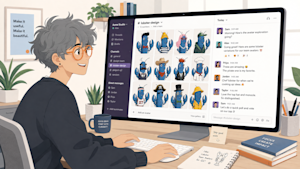
The new integration allows each AI agent to have its own identity, avatar, name, and even custom avatar. These agents can work together in Slack channels and shared canvases, and can be messaged across other platforms like Telegram or WhatsApp. This persistence and separation from single tasks is a significant improvement over previous AI agents that disappeared after one task.
Developers and enterprises can choose the underlying large language model (LLM) for their NanoClaw agents, allowing them to optimize for performance, cost, or other factors. NanoClaw's setup process for Slack is a significant improvement over traditional bot building, as it only requires a one-time connection to Slack and then provisions each additional agent as its own Slack bot with a unique name, avatar, and identity.
The lead agent uses the Model Context Protocol (MCP) tool to create new agents, define their instructions, personas, skills, and tools, and place them into shared rooms. Users can instruct the agent to create new agents for specific roles, such as product managers, architects, implementation agents, code reviewers, and testing agents, each with different toolsets and responsibilities. This division of labor is more than cosmetic, as each agent receives specific skills, instructions, and tools for different tasks.
Written by urgent.news from VentureBeat's reporting — not their text. Machine-written — may contain errors; check the original before relying on it.