Kyiv's desperate vendors persevere outside obliterated flea market
ON the scorching asphalt besides what was once a bustling Kyiv flea market, vendors were trying to sell the remains of their stock, ravaged by a Russian missile strike.
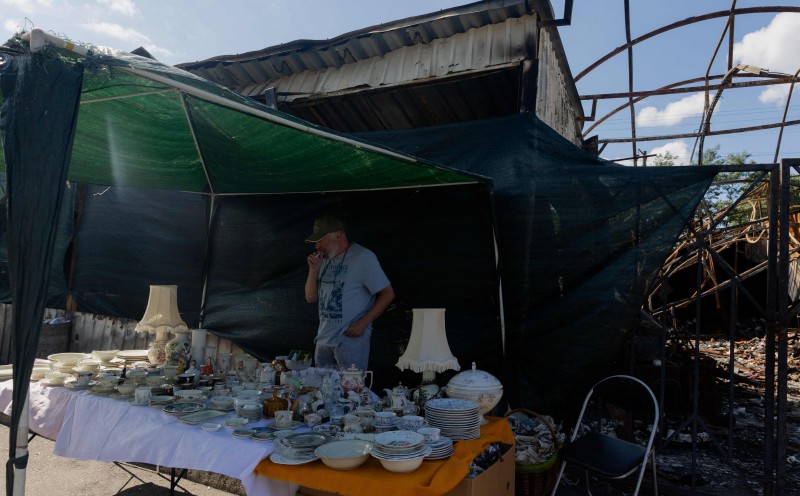
On a sweltering stretch of pavement, where once stood a lively Kyiv flea market, vendors were trying to make a living from the remnants of their stock, decimated by a Russian missile strike. Last month, the popular Pochaina site in Petrivka, located north of Ukraine's capital, was destroyed by Moscow in a major assault – the third such attack on the market since Russia's invasion began in February 2022.
Shards of glass and porcelain crunched beneath the feet of Vadym, a vendor, as he navigated the ruins of his shop. Valuable vinyl records and vintage audio equipment were reduced to a muddy mess, dotted with ashes and shattered fragments. Vadym recounted that the collection included four autographs from Led Zeppelin and another from Jim Morrison.
Holding up a piece of a rusted bicycle frame from 1979, he highlighted the sentimental value of some items. The once-thriving market, which moved to a permanent building in the early 2010s and rented out small spaces or containers, was now reduced to a patchwork of twisted metal and charred rubble. All vendors who still possessed something worth selling had been forced onto the street.
Since Russia's invasion in 2022, at least six Kyiv markets have suffered damage or destruction, according to an AFP tally. Another striking example is the central Lukyanivka market, where a handful of sellers gather in front of the smoldering shell, offering tomatoes, cheese, and cured meats on makeshift tables. Last weekend, yet another Russian strike set a major book market ablaze, scorching thousands of volumes and leaving charred pages across the streets.
When AFP journalists visited the Pochaina flea market ten days after the attack, the scent of burnt metal and plastic still lingered in the air. Some customers continued to visit, hoping to find a rare treasure amidst the clothing, records, dishes, and other items. A woman approached the stall where Vadym and his wife, who sells porcelain, had laid out what they had left, inquiring about the price of an elegant lamp with a cream-colored shade.
Vadym, who preferred not to provide his surname, expressed his optimism, stating, "We are optimists." Victoria, a 36-year-old genealogist, visited the market for the first time, emphasizing the resilience of the vendors and businesses affected by the war. Her own finances had suffered due to the economic pressures of the conflict.
Svitlana, a 63-year-old woman, witnessed half of her stock of vintage bags and dishes destroyed in a previous Russian strike, leaving her with only melted glass puddles. She emphasized their struggle to find means of livelihood, as they are self-employed and do not receive any salary. The plastic table she used to sell a few remaining items bought with donations and the umbrella shielding her from the unrelenting sun were purchased through government forms demanding compensation from Russia.
However, vendors have little hope of rebuilding the market before the end of the war, as Russia continues to launch daily attacks on Ukraine, killing hundreds of civilians each month and pushing millions into poverty. Diplomatic efforts to end the war are currently at a standstill. Oleksandr, sitting in the shade, observed his goods – paintings, electronic components, toys, and old phones – spread out on wooden blanks on the tarmac.
He noted that there are now ten times fewer customers, and people who once collected things, stocked up on items, or took an interest in them are gone. The priority for many now is food.
Written by urgent.news from New Straits Times's reporting — not their text. Machine-written — may contain errors; check the original before relying on it.
This story
This is one outlet's version. Read the fullest account.