Construction in Austria Revealed a Roman-Era Mass Grave Beneath a Soccer Field. New Research Suggests That the Men's Enemies Targeted Their 'Sensitive Areas'
No written records mention a fight in this specific part of Vienna at the time of the men's deaths. But the brutal nature of their injuries, particularly to the pelvis area, indicates that these individuals died on the battlefield
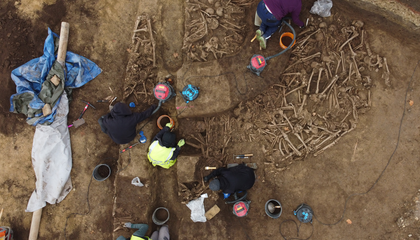
In October 2024, Austrian construction workers building a soccer field uncovered a mass grave from the Roman era, dating back to either the late first or early second century CE. The initial examination suggested the burial may have held up to 150 young men who met violent ends. Bioarchaeologist Sheridan Strang, from Vienna-based archaeology firm Novetus, shared the findings at a recent Paleopathology Association conference, detailing the detailed injuries the men sustained in their final moments.
According to Strang, at least 48 of the skeletons showed signs of physical trauma, with injuries primarily occurring around the time of death. The most common type of injury was to the pelvic area, while sharp force wounds were concentrated around the skulls, suggesting the attackers were aiming for sensitive areas. The sheer number and nature of injuries rule out possibilities like executions for cowardice and indicate the end of a catastrophic military operation.
The burial site, located on Hasenleitengasse in Vienna's outskirts, also yielded an iron dagger, scale armor, and a piece of a helmet, supporting the theory that the men were military personnel. Interestingly, ancient Vienna was home to a Roman military base called Vindobona. Although the region was generally peaceful between 50 and 120 CE, written sources mention Germanic groups crossing the Danube into Roman territory in 92 CE, leading to the demise of an entire imperial legion.
While scholars can't definitively say these men were casualties of that clash, the mass grave offers unique physical evidence of soldier injuries during Rome's imperial era. Unlike cremation, which was the norm for Roman war dead and everyday citizens, the discovery of battlefield burials during the third century is rare. Strang's work has not yet been published in a peer-reviewed journal, but historian David Potter from the University of Michigan suggested the mass grave could reflect a Roman defeat and burial of troops after the fact.
Written by urgent.news from Smithsonian's reporting — not their text. Machine-written — may contain errors; check the original before relying on it.