Broadening access to Skala creates a faster path to predictive DFT
Skala 1.1, the updated deep-learning exchange-correlation functional from Microsoft Research, provides greater accuracy, expanded accessibility across the computational chemistry ecosystem, and a living benchmark to track computational performance. The post Broadening access to Skala creates a faster path to predictive DFT appeared first on Microsoft Research .
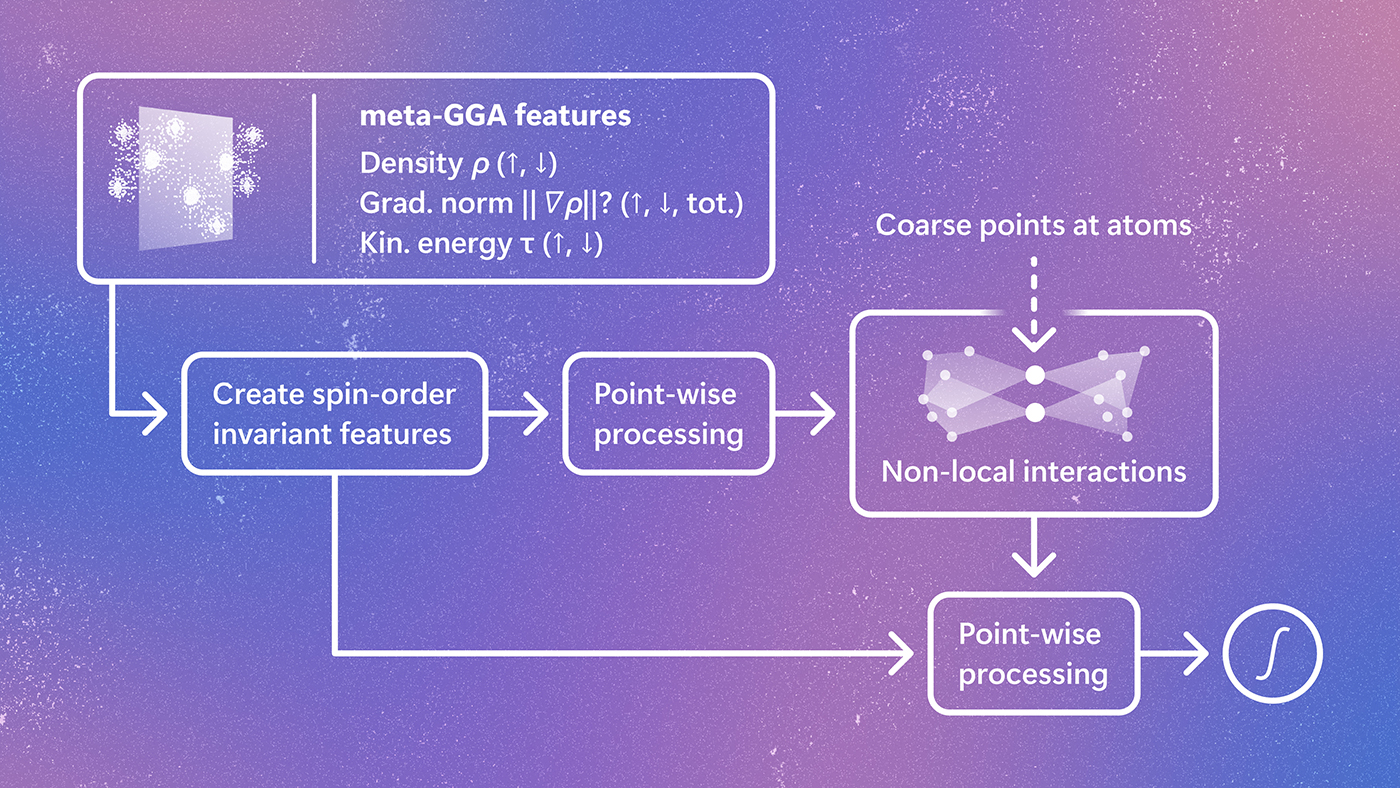
Skala 1.1, an advancement from Microsoft Research's deep-learning DFT approach, showcases improved accuracy by being trained on 2.5 times more data than its predecessor. This enhanced model delivers higher precision across various molecular simulation tasks, such as thermochemistry, reaction kinetics, and molecular structure prediction.
Skala 1.1 is now integrated into several electronic-structure software packages, including CP2K, Psi4, FHI-aims, ORCA, and VASP, making next-generation DFT accuracy more accessible to communities that rely on these codes daily.
Microsoft Research is also introducing a living benchmark to track the computational performance of successive Skala releases, enabling the community to measure and accelerate progress toward greater accuracy and efficiency. Skala 1.1 achieves a weighted average error of 2.8 kcal/mol on GMTKN55, outperforming leading global hybrid functionals while maintaining the efficiency of a semi-local functional. Additionally, it provides highly accurate electron densities, dipole moments, and molecular geometries.
Skala follows a continuous-improvement philosophy, where each release outperforms its predecessor while maintaining the same computational cost. This approach was made possible by expanding the Microsoft Research Accurate Chemistry Collection (MSR-ACC), which now includes new categories like electron affinities and noncovalent clusters.
By integrating Skala into major software packages, scientists in both academia and industry can rapidly and seamlessly access the latest DFT advancements, fostering a faster feedback loop for ongoing development.
Written by urgent.news from Microsoft Research's reporting — not their text. Machine-written — may contain errors; check the original before relying on it.