BRICS+ Series: Iran Pushes BRICS to Build Its Own Financial Corridor
Iran urges BRICS to build a shared payment corridor, linking national systems to cut costs and dodge Western-controlled financial networks.
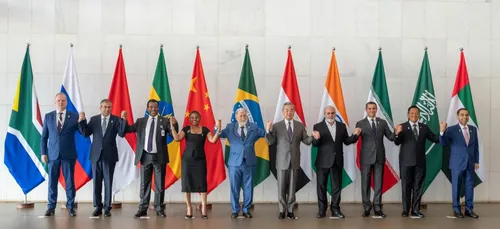
Iran's Central Bank Governor Abdolnasser Hemmati urged BRICS nations to move beyond discussions and begin constructing a dedicated financial corridor when he addressed the inaugural BRICS finance ministers and central bank governors meeting in Jaipur, India. Hemmati proposed the establishment of a dedicated financial corridor, interconnecting payment systems of member countries, advocating for the utilization of banks and traders for cross-border money transactions.
He emphasized that this approach would enable faster transactions, reduced costs, and enhanced resilience against external financial disruptions. For Iran, grappling with prolonged SWIFT network exclusion and US sanctions, Hemmati's suggestion represents a survival strategy. He further stated that Iran has initiated groundwork on the legal and technical facets for linking payment systems and offered to contribute to drafting a roadmap.
Iran joined BRICS' electronic banking platform, BRICS PAY, in 2023, as a means to circumvent SWIFT restrictions. Following its formal entry into BRICS in 2024 alongside Egypt, Ethiopia, and the UAE, Iran's central bank has maintained a presence in BRICS' working groups on cross-border payments, national currencies, fintech, and AI and cybersecurity.
Hemmati used the Jaipur meeting to also push for Iran's potential inclusion in the BRICS-run New Development Bank, founded in 2015 by Brazil, Russia, India, China, and South Africa to finance infrastructure and development projects. He announced that Iran's entry into the bank is imminent and deemed it the most significant outcome of BRICS cooperation thus far.
The geopolitical climate also played a role in Hemmati's comments, as he referenced recent US-Israeli military action against Iran and stressed that financial stability is contingent upon peace and compliance with international law. India's central bank governor Sanjay Malhotra echoed similar sentiments at the same meeting, stating that BRICS countries are exploring connections between their domestic fast-payment systems and contemplating the integration of central bank digital currencies into the same network.
However, it is important to note that these discussions are still in the exploratory phase, and an actual shared system has not been established. Building shared payment infrastructure across countries with differing banking rules, currencies, and political landscapes is a complex and lengthy endeavor. Despite this, Iran has presented a concrete proposal and is prepared to undertake the technical work required.
Other BRICS members are aligning their discussions accordingly but have yet to formalize an actual system. Nonetheless, the overarching direction is evident: Iran has made de-dollarizing BRICS trade a primary foreign economic policy objective, and following the Jaipur meeting, it now possesses a tangible proposal for BRICS to consider.
Written by urgent.news from IOL's reporting — not their text. Machine-written — may contain errors; check the original before relying on it.