You Can Now See One of the Oldest Surviving Copies of 'The Odyssey' at the Metropolitan Museum of Art
The papyrus fragment contains three lines that don't appear in standard modern-day translations of Homer's epic poem
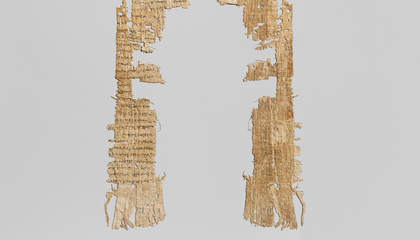
This summer, the Metropolitan Museum of Art in New York City is showcasing a rare artifact related to the epic poem, Homer's Odyssey. The object in question is a papyrus fragment dating back to the early Ptolemaic period, making it one of the oldest surviving copies of the poem. Discovered by archaeologists, this fragment is of historical significance, as it represents one of the earliest known renditions of The Odyssey and The Iliad.
The roughly 2,300-year-old papyrus fragment contains lines from Book 20 of the epic poem, where Odysseus, who has returned to Ithaca after a ten-year journey home, faces a challenging night preparing for a battle with the suitors seeking Penelope's hand in marriage. The goddess Athena appears in a dream to reassure Odysseus, and Zeus issues a thunderclap as a favorable omen for the king's impending confrontation.
Experts believe the papyrus was written in Egypt between 285 and 250 B.C.E. It was written using a stylus crafted from a sharpened reed, and the black ink was likely a mixture of water and lampblack. The papyrus is currently on display at the Met, alongside six other artifacts that bring the renowned Greek story to life in various and intriguing ways.
One of the unique aspects of this particular papyrus fragment is that it contains three lines that are absent from the standard text of The Odyssey used today. This discrepancy is attributed to the fact that there were many versions of Homer's epic, as recited by bards across the land. The Met's curator, Sean Hemingway, explains that these variations occurred as poets occasionally embellished the stories during their recitations.
While these 'wild' or 'eccentric' versions do not significantly alter the plot, they provide valuable insights into the diverse ways the poem has been interpreted throughout history.
Written by urgent.news from Smithsonian's reporting — not their text. Machine-written — may contain errors; check the original before relying on it.