Xi Jinping’s Jiang Zemin: Rewriting the ‘Reform Era’ to Serve the ‘New Era’
Xi’s commemoration of Jiang was ultimately less an exercise in historical remembrance than an attempt to impose continuity on the CCP’s post-Mao history.
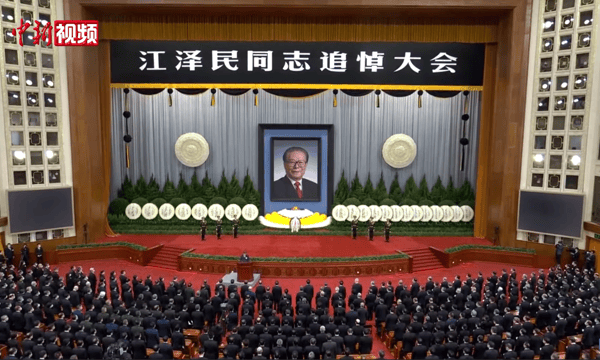
On August 17, Xi Jinping paid tribute to the late Jiang Zemin, the former General Secretary and President of China, on the occasion of his 100th birth anniversary. While the speech was primarily a commemoration, it also served a strategic purpose. Xi Jinping sought to rewrite Jiang's legacy to align with his "new era for socialism with Chinese characteristics." In doing so, he constructed a version of Jiang's legacy that emphasized his role as the foundation for Xi's ideological and political vision.
Firstly, the speech highlighted Jiang's essential link in the development of "socialism with Chinese characteristics" from Mao to the present. Jiang's leadership was portrayed as crucial in guiding China through its "new situation of comprehensive reform and opening up," with his unwavering commitment to the party's basic theory, line, and strategy. This narrative framed Jiang as a loyal servant and protector of the CCP's political and ideological heritage.
Secondly, the speech emphasized Jiang's staunch defense of the party's supremacy. Xi Jinping emphasized Jiang's unwavering political faith in Marxism, communism, and "socialism with Chinese characteristics." He highlighted Jiang's handling of various "major tests" in domestic and international politics, such as the "June 1989" and the Taiwan Straits Crisis of 1995-96, where Jiang firmly upheld the "Four Cardinal Principles" and ensured the country's independence, dignity, security, and stability.
This portrayal of Jiang as a strict guardian of the party's power served to reinforce Xi Jinping's own emphasis on CCP unity, discipline, and political control.
Thirdly, the speech underscored the legacy of "reform and opening" during Jiang's tenure. Jiang was praised for adapting a "new pattern" of opening up for the "socialist market economy," which included multiple forms of ownership, encouraging foreign investment, and China's accession to the World Trade Organization (WTO). This innovation was seen as a necessary adaptation to changing historical conditions, not a deviation from Marxism-Leninism.
This ideological point served to underline the necessity of innovation in preserving Marxism's relevance and established Jiang as a precedent for Xi's claim to have adapted Marxism in the form of "Xi Jinping Thought on socialism with Chinese characteristics."
Lastly, the speech contrasted Jiang's optimistic perspective on China's strategic opportunities during his time with Xi's more recent, more somber rhetoric. While Jiang saw the CCP establishing the "basic guidelines of seizing opportunities, deepening reform, expanding openness, and promoting development" for "rejuvenating the country," Xi emphasized the need to strengthen the party's sense of crisis, establish bottom-line thinking, and better coordinate development and security.
This contrast reinforced the CCP's evolving view of the relationship between development and security, which has been evident since at least the 20th Party Congress in October 2022.
In conclusion, Xi Jinping's speech about Jiang Zemin's legacy was less a historical remembrance and more an attempt to impose continuity on the CCP's post-Mao history. By presenting Jiang's era as a necessary stepping-stone to the "new era," Xi Jinping absorbed him into the prevailing ideological discourse, in which Jiang's innovations were not ruptures but evidence of the CCP's ongoing evolution.
Written by urgent.news from The Diplomat's reporting — not their text. Machine-written — may contain errors; check the original before relying on it.