Webb Captures the Treasure Chest at the Heart of the Carina Nebula
This NASA/ESA/CSA James Webb Space Telescope Picture of the Month takes us to a fantastical realm within our home galaxy, where piercing starlight and billowing winds sculpt dust clouds into inventive shapes. This scene is from the Carina Nebula, which lies just 7500 light-years away in the constellation Carina (the Keel).
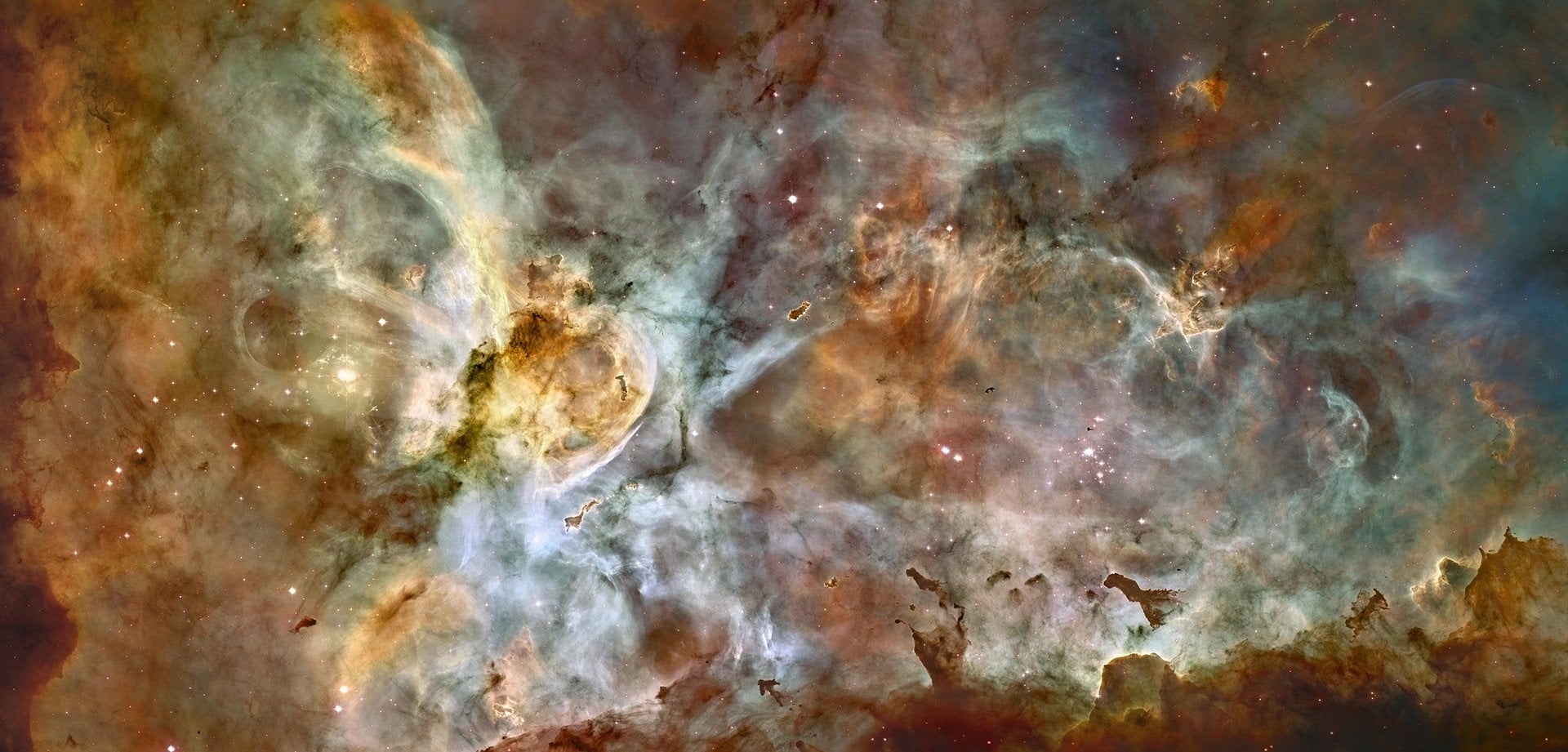
The Carina Nebula, situated approximately 7,500 light-years away in the constellation Carina, has long been a favorite target for the Hubble Space Telescope. This month, the James Webb Space Telescope (JWST) captured a stunning image of this nebula, showcasing its intricate structures and vibrant colors. As the Picture of the Month on the ESA's website, the JWST image of the Carina Nebula highlights a mesmerizing feature known as the Treasure Chest.
Measuring about 260 light-years in diameter, the Carina Nebula is the closest high-mass star-forming region in our Milky Way galaxy. This proximity enables astronomers to study the various stages of star formation within the nebula, where tens of thousands of protostars are found along with some of the most massive stars in the galaxy. The JWST image reveals these hot, massive young stars, along with the surrounding dust clouds shaped by their intense radiation and stellar winds.
One of the most striking features in the JWST image is the Treasure Chest, an isolated cloud of gas and dust with a dark, dense head and an extended tail. Often resembling a cometary globule, this cloud resembles a wooden chest with its lid open wide. At its heart lies a compact cluster of young stars, estimated to contain around 70 stars.
Among these, the most massive stars are rare blue-white O-type stars, which are extremely hot, approximately 30,000 Kelvin in temperature, and about 19 times more massive than our Sun. These stars give the Treasure Chest its ethereal glow, as captured by the NIRCam instrument on the JWST.
The structure of the Treasure Chest is primarily determined by Eta Carinae, the brightest object in the nebula, located 39 light-years northwest of the feature. Eta Carinae is a binary system, with one star being roughly 100 times as massive and 5 million times as luminous as the Sun. The star cluster within the Treasure Chest is approximately 1.3 million years old, with some individual stars having circumstellar disks that will eventually form new planets.
Over time, the intense starlight from these young stars will dissipate the clouds that compose the Treasure Chest, gradually revealing the entire star cluster and providing astronomers with an unprecedented view of the early stages of star formation within the Carina Nebula.
Written by urgent.news from Universe Today's reporting — not their text. Machine-written — may contain errors; check the original before relying on it.
This story
This is one outlet's version. Read the fullest account.