Track defect found near derailment site - report
Initial findings from an RAIB investigation show an "irregularity" at the site near Lewes.
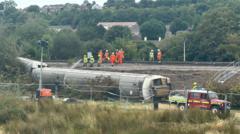
A defect was discovered on railway tracks in East Sussex near the site where a train derailed, injuring 30 people according to a report. The Rail Accident Investigation Branch (RAIB) found an irregularity with the tracks close to Lewes where three carriages tumbled down an embankment last Thursday. The RAIB, still investigating the derailment, received reports of rough riding at the crash location from passengers of other trains.
Both Network Rail and Greater Thameslink Railway, which operated the Southern Rail train involved in the crash, expressed regret over the incident. CCTV footage showed the track geometry irregularity just before the train came off the tracks. The 14:24 train from London Victoria to Eastbourne derailed in the Landport area of Lewes around 15:54 BST.
The eight-carriage train was traveling at about 65 mph, within the 70 mph speed limit, when it derailed. The driver had begun to brake as the train approached the crash site. The accident occurred during a period of hot and dry weather, with temperatures reaching 33°C (91.4°F) before the crash. The RAIB's ongoing investigation will examine factors like how the section of track was inspected and maintained, the condition and maintenance of the embankment, weather conditions, and the effectiveness of hot weather mitigation measures.
Network Rail's route director for Sussex and Greater Thameslink Railway's CEO apologized for the derailment and pledged to consider the investigation's recommendations and work across the industry to enhance safety. Last week, Network Rail's group safety and engineering director stated that speed restrictions were not in place at the derailment location and emphasized the railway's safety, mentioning various measures to manage weather impacts.
The Department for Transport affirmed that safety remains the top priority across the UK's railways, which are among the safest in the world, with delay caused by track faults falling by 45% since the late 2000s.
Written by urgent.news from BBC Business's reporting — not their text. Machine-written — may contain errors; check the original before relying on it.