The east coast's first lighthouse
The old picture this week takes in the Bluff Lighthouse or the HC Cooper Lighthouse, named after South Africa’s first Lighthouse Engineer
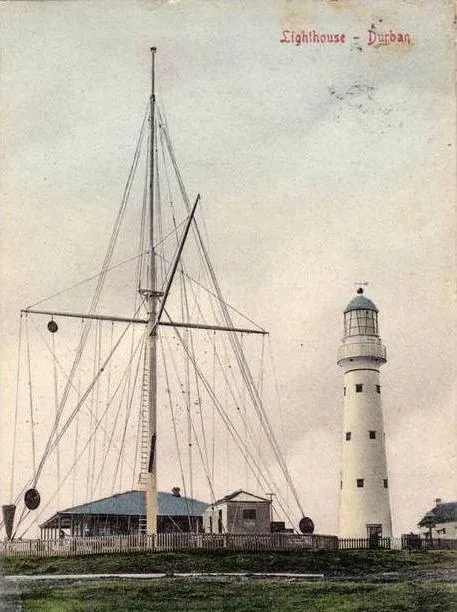
The Bluff Lighthouse, also known as the HC Cooper Lighthouse, marked a significant milestone on the Natal coastline as South Africa's first lighthouse. Originally constructed in 1864, the edifice took three years to build, primarily due to material delays. Situated on the seaward end of the Bluff, the lighthouse was officially inaugurated in 1867, serving as Durban's beacon for over six decades.
At its peak, the apparatus comprised a fifth-order dioptric two-panel system, emitting a powerful flash of 1 million candlepower. The intensity was later heightened to 1.3 million candela with the introduction of a 1,500-Watt lamp.
However, the lighthouse's safety was called into question in 1933 when an earth tremor prompted a newspaper report suggesting that it had been deemed unsafe. Cooper, the lighthouse engineer, addressed these concerns by highlighting the need for repairs due to age and poorly designed foundations. This led to the lighthouse undergoing refurbishment, which persisted through World War II.
During this period, the Cape Garrison artillery's six-inch guns threatened damage to the lighthouse, compelling its eventual demolition in 1941.
In its place, two new lighthouses were erected: the Cooper Light on Brighton Beach and the Umhlanga Rocks Lighthouse. Both structures were virtually identical except for their tower colors and the characteristics of their respective lights. The Cooper Light was commissioned in July 1953, followed by the Umhlanga Rocks Lighthouse a decade later. Lastly, an automated Chance Brothers lens, installed in 1942, continued to illuminate the sky in the new lighthouse, 11 years after its construction.
Written by urgent.news from IOL's reporting — not their text. Machine-written — may contain errors; check the original before relying on it.