Urgent.News

One page, thousands of outlets. See who else covered it.

Editions

Science

冻土图案的形成源于重力和奇特的物理现象

冻土的一个神秘特征,可以用非牛顿流体物理学来部分解释。这就是“奥布雷克”(Oobleck)。

冻土图案的形成源于重力和奇特的物理现象

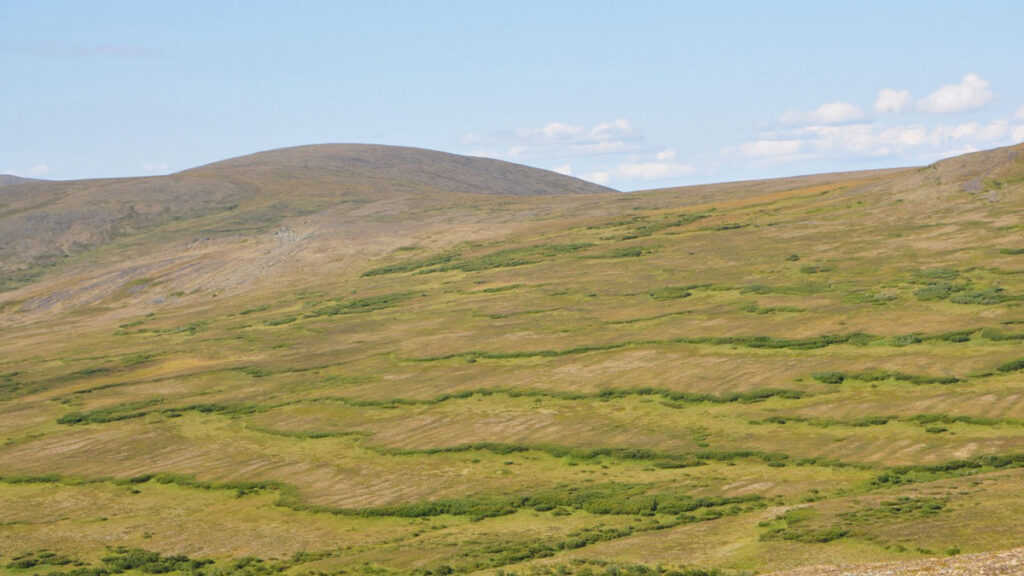
In the Arctic, polygonal patterns on frozen soil coverings arise from gravity and unique physical phenomena. These patterns, ranging from circular to polygonal shapes, can also resemble sunken fields of rectangular blocks. As climate change accelerates the thawing of permafrost, understanding the formation of these patterns is crucial for predicting and repairing unstable slopes in the region.

Additionally, these patterns may provide insights into Mars' past climate, as scientists have discovered similar terrain on the Martian surface.

The formation of these polygonal patterns in frozen soil is a complex process, involving the slow movement of ice-soil mixtures, often just a few millimeters to centimeters per year. This movement can behave like a fluid or a solid, depending on the varying conditions of water content, temperature, and the inherent physical laws of the soil. Researchers have ruled out other commonly used fluid analogies, like falling paint droplets on a wall, lava rafting, and rolling waves, in explaining the formation of these patterns.

After reviewing soil literature, running physical process-based computer models, and simulating the formation of ridged and leaf-shaped structures, researchers identified a suitable analogy: wave formation in a non-Newtonian fluid known as "Oobleck." Oobleck is a non-Newtonian fluid made from cornstarch and water, which changes its viscosity under different stresses and, surprisingly, becomes more difficult to move when more pressure is applied.

This unique physical property makes Oobleck a popular tool for educational demonstrations and closely resembles the observed features of frozen soil in the natural world.

However, the current model has its limitations, as it only reflects the flow behavior of the soil (or fluid), not its actual material composition. In reality, permafrost is much more complex than a mere mixture of cornstarch and water. The formation of these polygonal patterns requires a raised structure, as well as sufficient soil moisture to accumulate ice layers.

While researchers hope to validate their model in the field, the formation of these patterns takes hundreds or even thousands of years, making direct observation challenging but not impossible. The researchers are determined to attempt it despite the difficulty.

Written by urgent.news from Eos's reporting — not their text. Machine-written — may contain errors; check the original before relying on it.
Read the original at eos.org →

More in Science

Turning a quantum battery's environmental sensitivity into an advantage

Quantum batteries, devices that store energy by exploiting quantum mechanical phenomena, could, in principle, be charged faster and more efficiently than classical ones. Despite their potential, connecting these batteries to chargers is known to create quantum correlations that can trap some energy inside the combined battery-charger…

More from Wednesday 19 August →