Low water: ADAC: Traffic jams do not materialize despite relaxed truck driving ban
Because only a few ships can sail on the Rhine due to the low water level, trucks are supposed to help with transports - also on Sundays. Initial assessments show how this affects traffic.
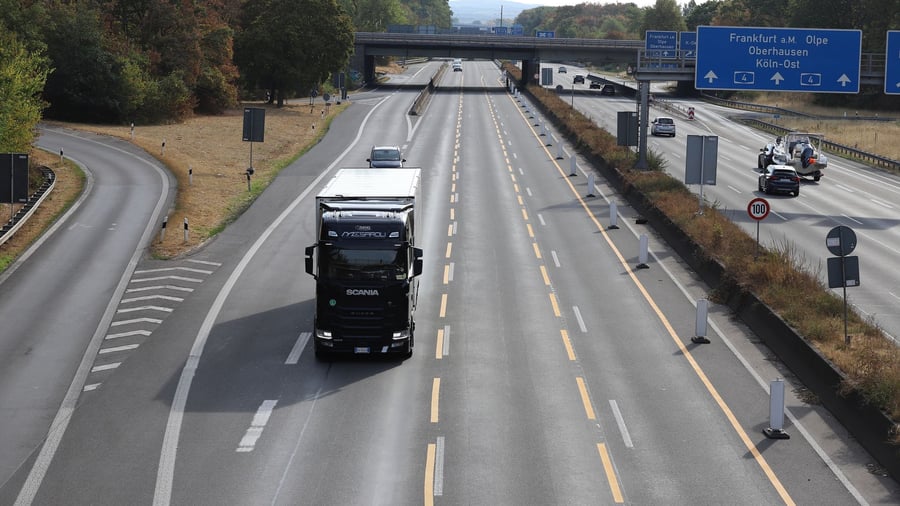
The German automotive club ADAC reported that despite a relaxation of the truck driving ban on Sundays due to low water levels, traffic jams on German roads have not worsened. According to ADAC, there were fewer traffic jams on Sunday compared to the same weekend last week, and there were no notable differences when compared to Sunday of the previous year.
The number of traffic jams was slightly higher than in 2025, but they were shorter and less long-lasting. Therefore, the lifting of the truck driving ban had minimal impact on the nationwide traffic situation.
The Speditionsverband BGL also stated that they see no significant consequences in the traffic. According to BGL's chief executive, Dirk Engelhardt, there is no widespread increase in truck traffic. In North Rhine-Westphalia, a slightly higher truck traffic was observed after initial observations, while no significant increase was seen in Bavaria and Baden-Württemberg.
Most federal states temporarily relaxed the truck driving ban on Sundays and holidays to alleviate the consequences of low water levels on the Rhine and other rivers. This was aimed at shifting goods that cannot be transported easily by ship due to low water levels.
Despite the criticism from Green, Left, and environmental associations, Engelhardt noted that the additional possibilities for shifting transports were used only in "surprisingly small amounts". The lifting of the Sunday driving ban can make existing capacities more flexiblely usable, but it does not create additional drivers or additional legal driving hours.
According to previous BGL data, there are still more than 100,000 drivers missing in Germany. Moreover, a large portion of vehicles is already planned for existing transports. Transporting goods is difficult to catch up with, Engelhardt added. Only about six million tons of freight per month would need to be moved otherwise, which is equivalent to roughly 3,000 freight trains or 250,000 truck loads.
Roads can help pointwise and especially in urgent transports, but they cannot replace the capacity loss in the context of barge transport. Barges primarily transport bulk goods such as iron ore, coal, construction materials, or mineral oil products in large quantities. For example, a barge load of 1,500 tons corresponds to roughly 60 truck loads with an assumed payload of 25 tons, Engelhardt calculated.
Written by urgent.news from Handelsblatt's reporting — not their text. Machine-written — may contain errors; check the original before relying on it.