Interstellar Travel IV: Solar, Magnetic, & Directed-Energy Sails
In our fourth installment in the Interstellar Travel series, we'll examine solar sails, magnetosails, and directed-energy propulsion (DEP), which are currently the most plausible methods for reaching another star system within a human lifetime.
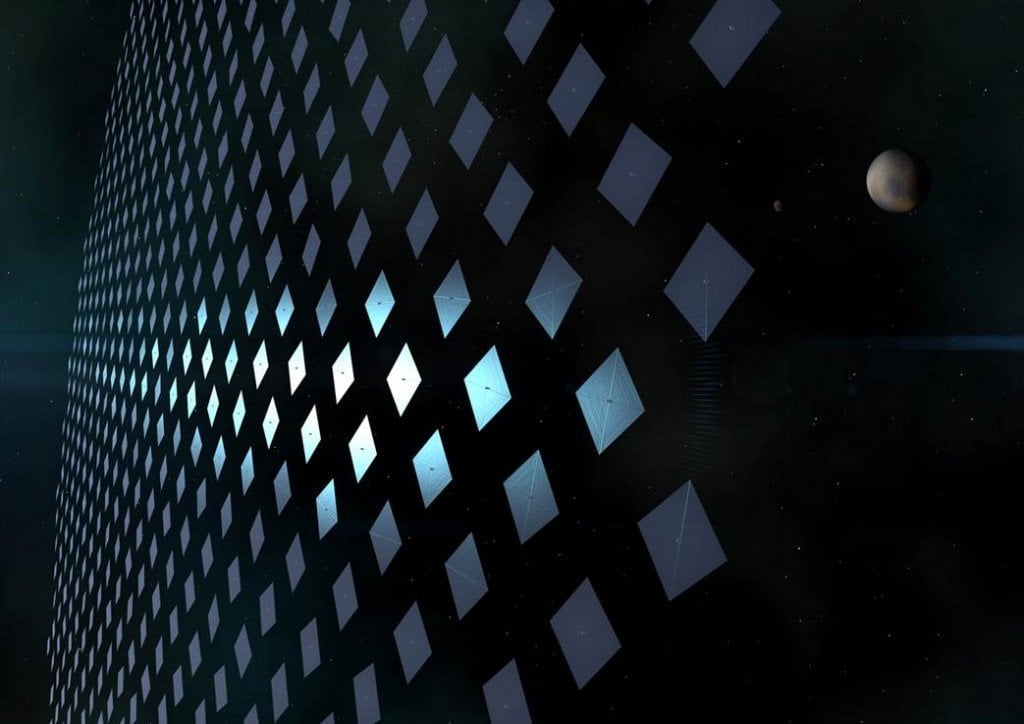
In this latest installment of our series on interstellar travel, we explore practical propulsion methods using radiation pressure and electromagnetism to create interstellar spacecraft. Solar sails, magnetic sails, and laser-driven lightsails have all been proposed as cost-effective alternatives to traditional propulsion systems.
Solar sails rely on the Sun's radiation pressure, requiring no fuel, while magnetic sails use a superconducting loop to harness solar wind. Laser-driven lightsails, on the other hand, receive thrust from directed energy beams.
Historically, James Clerk Maxwell's research on electromagnetic phenomena laid the foundation for lightsails in the 19th century. Russian physicist Pyotr Lebedev and Ernest Nichols & Gordon Hull conducted early experiments demonstrating light pressure, and Konstantin Tsiolkovsky proposed using sunlight to propel spacecraft in 1921. Later, Friedrich Zander and JBS Haldane further theorized about the potential of solar sails, while Carl Sagan popularized the concept in public discourse.
In 1972, Haldane wrote about using metallic foils to catch solar radiation pressure, and Carl Sagan detailed a future spacecraft rendezvous with Halley's Comet. In 1988, Dana G. Andrews and Robert Zubrin proposed the first magnetic sail (magsail), a concept that involved a superconducting loop with a 50-100 km radius and a mass of about 100 metric tons. Since then, various designs have aimed to reduce mass and harness thrust mainly from solar wind.
In 2000, Robert M. Winglee proposed the Mini-Magnetospheric Plasma Propulsion (M2P2) design, which used low-energy plasma injected into a smaller coil for propulsion. In 2012, a team at the Japan Aerospace Exploration Agency (JAXA) developed the Magneto-Plasma Sail (MPS), which demonstrated that lower density and velocity plasma resulted in better performance.
In 2021, researchers from Xi’an Aerospace Propulsion Institute proposed an electromagnetic sail that combined a magnetic and an electric sail, potentially providing additional thrust through a superconducting magsail coil and an electron gun at its center. Robert Forward also proposed a laser-driven lightsail concept in 1984, enabling spacecraft to reach relativistic speeds without requiring propellant.
Written by urgent.news from Universe Today's reporting — not their text. Machine-written — may contain errors; check the original before relying on it.