From Requirement to Release: Building an AI Software Engineering Platform for Event-Driven Systems
An AI-native software engineering reference architecture that orchestrates requirements, architecture, verification, release, and production intelligence.
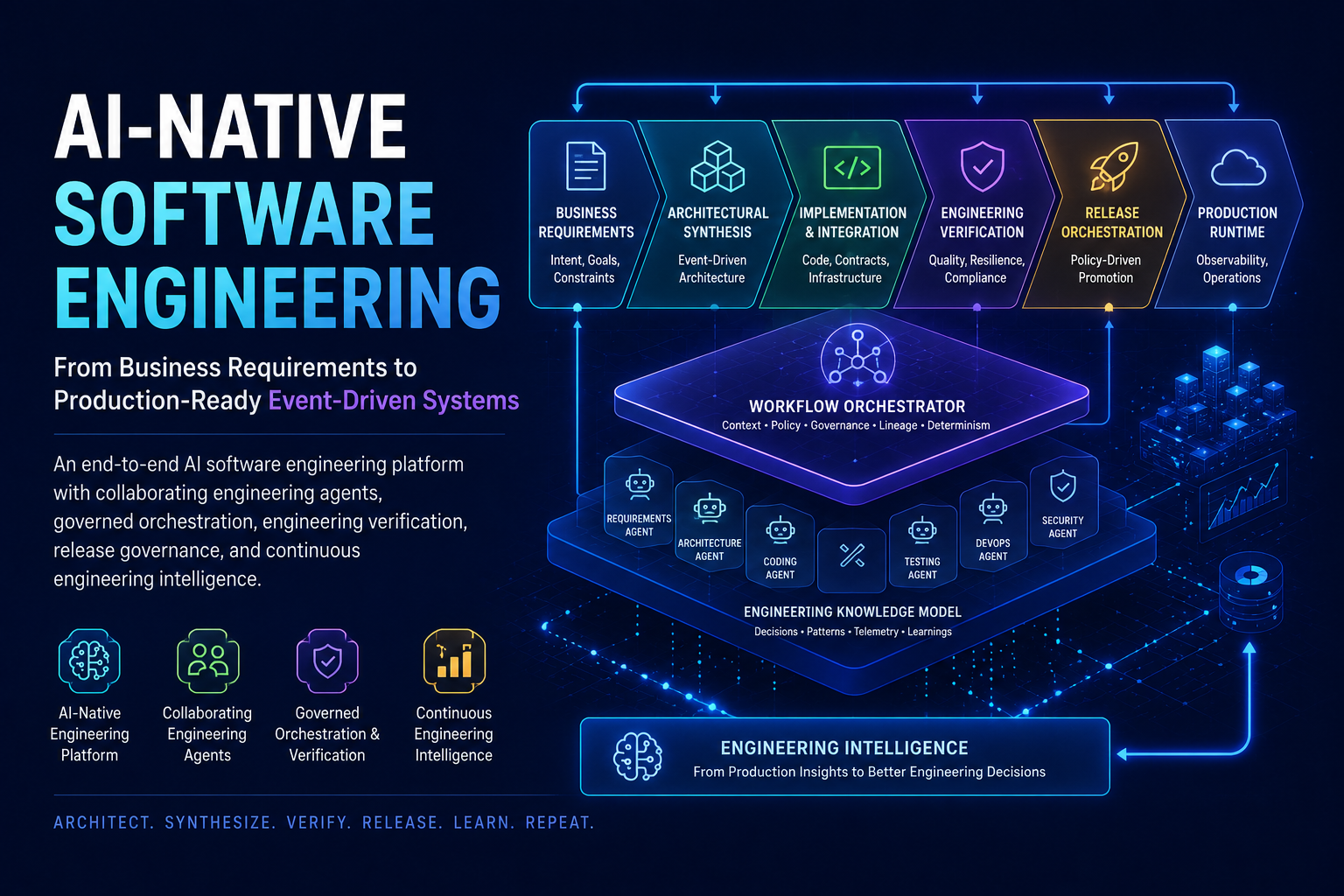
The subsequent wave of AI software engineering solutions will be judged by their capacity to manage the entire software development pipeline, not merely by their ability to produce code. Modern applications are dynamic, evolving through various stages such as requirement gathering, architectural planning, implementation, testing, DevOps, release management, and operational insight.
These stages interact by sharing information, limitations, choices, and execution data. Enhancing a single stage does not improve the entire system. The primary challenge is not creating a more proficient coding tool, but constructing an AI-coordinated platform that synchronizes autonomous engineering processes while maintaining architectural integrity, policy compliance, governance, and accountable release decisions throughout the delivery lifecycle.
The Workflow Orchestrator acts as the central coordinator, managing specialized engineering agents responsible for requirement analysis, architecture synthesis, planning, code generation, verification, documentation, DevOps, release management, and production learning. Each agent is responsible for a distinct aspect, collaborating through shared workflow state, versioned artifacts, and explicit architectural decision boundaries.
The platform segregates AI reasoning from engineering control, enabling agents to carry out tasks like requirement analysis, architectural design, implementation planning, code creation, documentation, pull-request creation, verification, release management, and production learning with minimal human intervention. Humans, however, remain accountable for business intent, organizational policies, architectural exceptions, risk acceptance, and approvals that cannot be safely automated.
The orchestrator maintains the workflow's state, authoritative context, artifact lineage, policy enforcement, and execution continuity. It interfaces with enterprise systems via standardized MCP integrations, ensuring flexibility and avoiding vendor-specific dependencies within the orchestration model. The result is an AI-native Software Engineering Platform, where collaborating agents automate business requirements into production-ready event-driven distributed systems through autonomous execution, evidence-based verification, controlled release, and continuous production learning.
Written by urgent.news from HackerNoon's reporting — not their text. Machine-written — may contain errors; check the original before relying on it.