Fly around Schiaparelli Crater with Mars Express
Video: 00:04:10 ESA’s Mars Express takes us on another mesmerising flight, this time around one of the biggest craters on Mars. Despite measuring a huge 460 km across, Schiaparelli Crater seems to be relatively shallow. Perhaps it has been filled in over the last few billion years by sediment blown by the wind or deposited by water, by lava – or by a combination of all three. Schiaparelli Crater…
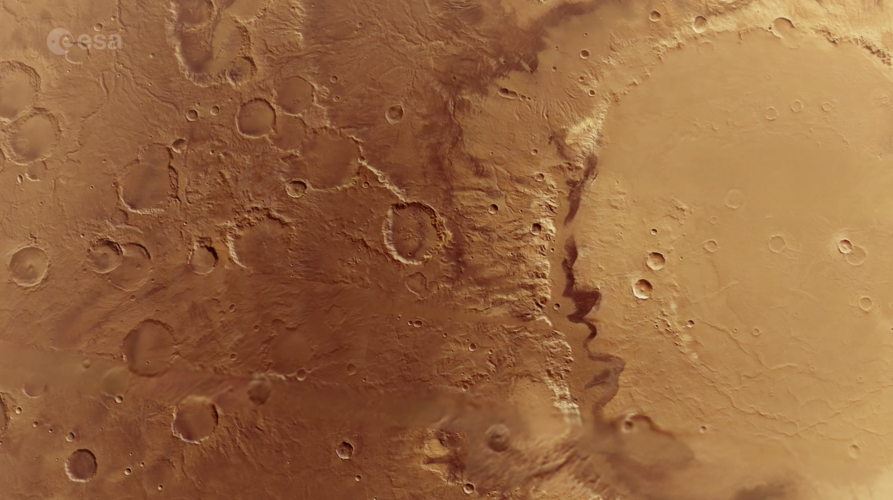
ESA's Mars Express has once again provided a mesmerising flight, this time around the immense Schiaparelli Crater. Spanning an impressive 460 kilometres across, this crater appears relatively shallow, possibly filled in over many billions of years by wind-blown sediment, water, lava, or a combination of these elements.
Named after renowned Italian astronomer Giovanni Schiaparelli, the crater is a testament to his pioneering observations of Mars. During a 'Great Opposition' in 1877, Schiaparelli mapped the planet, detecting several straight dark lines across its surface which he initially believed to be natural water-filled channels, hence the term 'canali' in Italian.
Regretfully, he was misinterpreted by others as suggesting artificial irrigation systems, leading to the belief that Martians had built them. Today, we know this to be incorrect.
Schiaparelli Crater also plays a significant role in popular culture, being the final destination in Andy Weir's novel 'The Martian'. The film utilizes data from Mars Express' High Resolution Stereo Camera (HMC-30) and image mosaics, combining them with topography information from the digital terrain model to create a three-dimensional landscape.
Each second of the movie involves rendering 50 frames following a predetermined camera path, with vertical exaggeration set at three times. Atmospheric effects like clouds and haze have been added to conceal the model's limitations, starting to build up at 250 kilometres distance. The HRSC camera on Mars Express is operated by the German Aerospace Center (DLR), with the film produced by the Planetary Science and Remote Sensing group at Freie Universität Berlin.
Written by urgent.news from ESA Space Science's reporting — not their text. Machine-written — may contain errors; check the original before relying on it.