Comment | A Henry Moore exhibition at Kew highlights the uneasy relationship between art and nature
The great bronze brutalist forms seem more to suggest the impossibility of returning to natural innocence
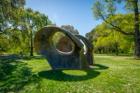
Henry Moore's sculptures are currently displayed at Kew Gardens in an arrangement that feels very much like their natural habitat: an English garden under the English light. Kew Gardens, where all of nature seems to gather, is the perfect backdrop for an exhibition of Moore's monumental works. In the gardens, one witnesses a grand drama where giant bronze forms converse with the surrounding trees, shrubs, and palm house flora. The sculptures seem to emerge from the nature around them, forming endless conversations.
Notable examples of this conversation can be seen in the sculpture Totem Head (1968) standing against the giant crown of the evergreen Atlas cedar, and the sculpture Oval with Points (1968-70) which almost touches the open branches of the verrucosa ash. The deodar tree at Kew, sprawling in an ungainly manner, provides an intriguing setting for Moore’s Hill Arches (1973), which is bathed in a light coppery green patina.
Moore’s Transformation Drawings from the 1930s, transforming stone and bone into living things, provide a stark contrast to the surrounding nature. In the Shirley Sherwood Gallery, these drawings create a backdrop for a dramatic conversation between Moore’s sculptures and the gallery's background.
However, beneath this idyllic setting, there is a sense of unease. Henry Moore's grandest sculpture, Three Piece Sculpture: Vertebrae (1968-69), stands solemnly beside the ornamental lake, surrounded by the airship-like Palm House. The smooth, bronze forms seem out of place in the natural setting, feeling more connected to the commercial jet planes flying overhead than the tranquil garden.
This uneasy relationship between Moore's sculptures and the natural world is further emphasized by the fact that over two-thirds of his works are located in North America, funded by US collectors and architects. Two of his late masterpieces, Knife Edge Mirror Two Piece (1977) and the Dallas Piece, have been installed in Washington, DC, and Dallas, respectively.
These sculptures, with their multi-directional forms, add an energetic and public aspect to the plaza where they stand, but both are currently under threat due to political changes in the area.
Kew Gardens serves as a reminder of Moore's transatlantic career, forcing us to question the idea of a simple relationship between sculptures and nature. Moore's sculptures are not just inspired by nature, but are also a testament to the complexity and mystery of the natural world, and the genius behind their fabrication. This exhibition at Kew Gardens invites us to reconsider our relationship with nature and the grandeur of Moore's art.
Written by urgent.news from The Art Newspaper's reporting — not their text. Machine-written — may contain errors; check the original before relying on it.