China’s LandSpace beats SpaceX with steel-booster recovery after orbital launch
In a global first, China’s leading commercial rocket company LandSpace has recovered a stainless-steel booster after an orbital launch, marking a major step in the country’s efforts to develop lower-cost, reusable rockets. The successful mission makes Zhuque-3 China’s first commercial rocket to both reach orbit and have its first stage recovered. SpaceX’s Super Heavy booster, which is also made…
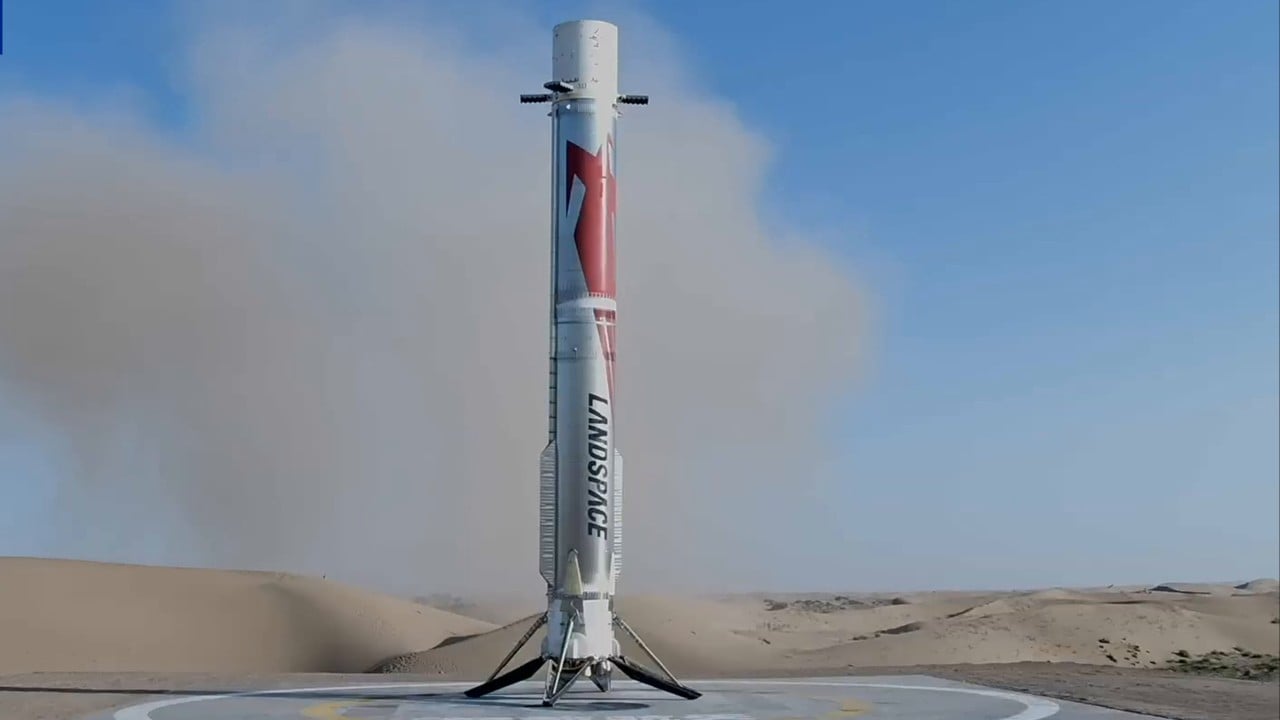
China's commercial rocket company LandSpace achieved a historic milestone by successfully recovering a stainless-steel booster after an orbital launch, surpassing SpaceX in this achievement. The Zhuque-3 rocket, which is also constructed from stainless steel, reached orbit and returned its first stage to Earth, becoming the first Chinese commercial rocket to accomplish this feat.
SpaceX's Super Heavy booster, similar in material to Zhuque-3, awaits approval from the US Federal Aviation Administration (FAA) before attempting its first recovery. This accomplishment makes LandSpace the fourth entity globally to recover a launch vehicle, joining US companies SpaceX, Blue Origin, and state-owned China Aerospace Science and Technology Corporation.
Orbiting at 66 meters (217 feet) tall, the Zhuque-3 rocket, fueled by liquid methane and oxygen, was launched from the Jiuquan Satellite Launch Centre in the Gobi Desert on Wednesday morning, according to Xinhua. Its mission successfully placed the Honghu-3 internet satellite into its designated orbit, while the rocket's first stage made a precise vertical landing at a recovery site in Minqin county, Gansu province, approximately 390 kilometers (242 miles) southeast of the launch pad.
This marked LandSpace's second attempt at launching Zhuque-3 into orbit and recovering its first stage. During the rocket's initial flight in December, the second stage reached orbit, but the first stage suffered a catastrophic failure during its final descent due to the engine failing to reignite at 3km above the ground.
This achievement signifies China's progress in developing lower-cost, reusable rockets, comparable to SpaceX's workhorse Falcon 9. The successful recovery of the first stage could prove vital for China's ambitious plans to construct broadband internet megaconstellations. These constellations, similar to SpaceX's Starlink, aim to provide global coverage through the deployment of over 10,000 satellites, creating a significant market and strategic military infrastructure.
Currently, SpaceX's Starlink has already deployed over 10,000 satellites and attracted more than 12 million customers worldwide, demonstrating both commercial and military potential. Beijing's Guowang constellation and the Shanghai-backed Qianfan network have each launched around 200 satellites so far, their expansion limited by the lack of a reusable workhorse comparable to the Falcon 9.
Written by urgent.news from South China Morning Post's reporting — not their text. Machine-written — may contain errors; check the original before relying on it.