Börsenstart in China: Roboterbauer Unitree startet mit über 600 Prozent Kursplus
Humanoid Roboter gelten in China als Zukunftsindustrie. Der Börsenstart von Unitree zeigt, wie groß die Erwartungen der Anleger sind. Dabei sind die Umsätze des Unternehmens noch gering.
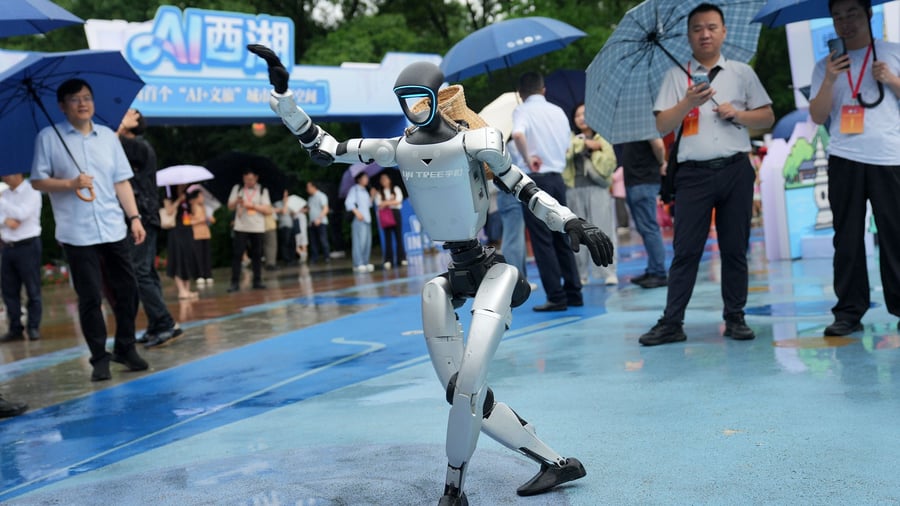
Chinese robot maker Unitree made a rapid entry onto the stock market, with its shares opening 629 percent above the offering price on Wednesday at Shanghai's technology-heavy Star Exchange. The price then pared some of its gains, still trading at around 500 percent above the initial offering by mid-morning. The stock cost nearly six times its listing price, valuing Unitree at around 57 billion euros.
Unitree was the first manufacturer of humanoid robots to be listed on a Chinese mainland stock exchange. The initial online tranche for retail investors was more than 8,000 times oversubscribed. The company raised about 780 million euros in its initial public offering. Founded in Hangzhou, eastern China in 2016, Unitree came to prominence with four-legged robot dogs and humanoid robots showing running, dancing and martial arts movements.
Its valuation vastly exceeds its actual 2025 turnover of 1.7 billion yuan (around 218 million euros) and the reported net profit of 278 million yuan. According to the company, it delivered over 5,500 humanoid robots in 2025, but the commercial use of such machines is still in its infancy. The stock frenzy fits a pattern of strong listing performances in China, with particularly high gains recently seen among hardware and AI companies in sectors like semiconductors and robotics, which Beijing is actively promoting to reduce dependency on foreign technology and build new growth engines.
Germany's machine builders view the massive global investments in humanoid robots with concern. "An intense global race for leadership in humanoid robotics and physical AI has already begun worldwide," warns Hartmut Rauen, deputy CEO of the German machinery association VDMA. "For Germany and Europe, much is at stake: competitiveness, technological sovereignty and industrial added value."
Germany and Europe have excellent technologies, strong industry firms, outstanding start-ups, and a leading research community. However, they are failing to transition innovations into large-scale production and swiftly penetrate markets. "Germany and Europe must build a comprehensive value chain with domestically produced critical components," urged Rauen.
Written by urgent.news from Handelsblatt's reporting — not their text. Machine-written — may contain errors; check the original before relying on it.