Xiaomi ‘in no rush’ to turn vast AI spending into profits despite earnings slump
Chinese technology giant Xiaomi has said it is “in no rush” to convert its large investments in artificial intelligence into profit, after recording another decline in net profits in the second quarter amid intense competition and cost inflation. “Our investment in AI is currently still in a phase of large-scale input. However, as a large corporation, Xiaomi is in no rush to pursue immediate…
Chinese tech giant Xiaomi has indicated it is not eager to turn its substantial investments in artificial intelligence into profits, following a decline in net profits during the second quarter amid fierce competition and rising costs. Alain Lam, vice president and CFO of Xiaomi, stated during an earnings call that the company is still in a phase of significant AI investment, yet it is not in a rush to monetize these efforts immediately.
The remarks come as global tech firms, including those in China and the US, increase their capital expenditure to fuel AI development, despite concerns about the return on such investments.
In the first half of 2023, Xiaomi's research and development spending grew by 25.6 per cent year on year to 18.2 billion yuan, with AI-related expenditures accounting for nearly 30 per cent of the total. Lam explained to reporters that while high memory prices and intense competition persist, the firm remains committed to its long-term strategy.
Xiaomi's overall revenue for the April-June period dropped by 6.1 per cent year on year to 108.9 billion yuan, and its net profit fell by 20.3 per cent year on year to 9.46 billion yuan. The figures, however, exceeded analysts' expectations of 108.3 billion yuan in revenue and 5.68 billion yuan in net profit.
The earnings report included 6.46 billion yuan in paper gains from financial instruments and 2.16 billion yuan in other income, primarily attributed to private investments and subsidies. Xiaomi's EV business showed a 15.9 per cent year-on-year increase in revenue, reaching 20.6 billion yuan, although growth was slower compared to the previous year's 233.9 per cent.
Monthly EV deliveries during the quarter were around 34,000 units, slightly down from 31,267 units in July, lagging behind rivals like Xpeng and Leapmotor. Despite the EV segment being a positive for Xiaomi, sluggish sales have made it challenging to achieve the company's goal of 550,000 vehicle deliveries this year, according to JPMorgan and Bernstein analysts.
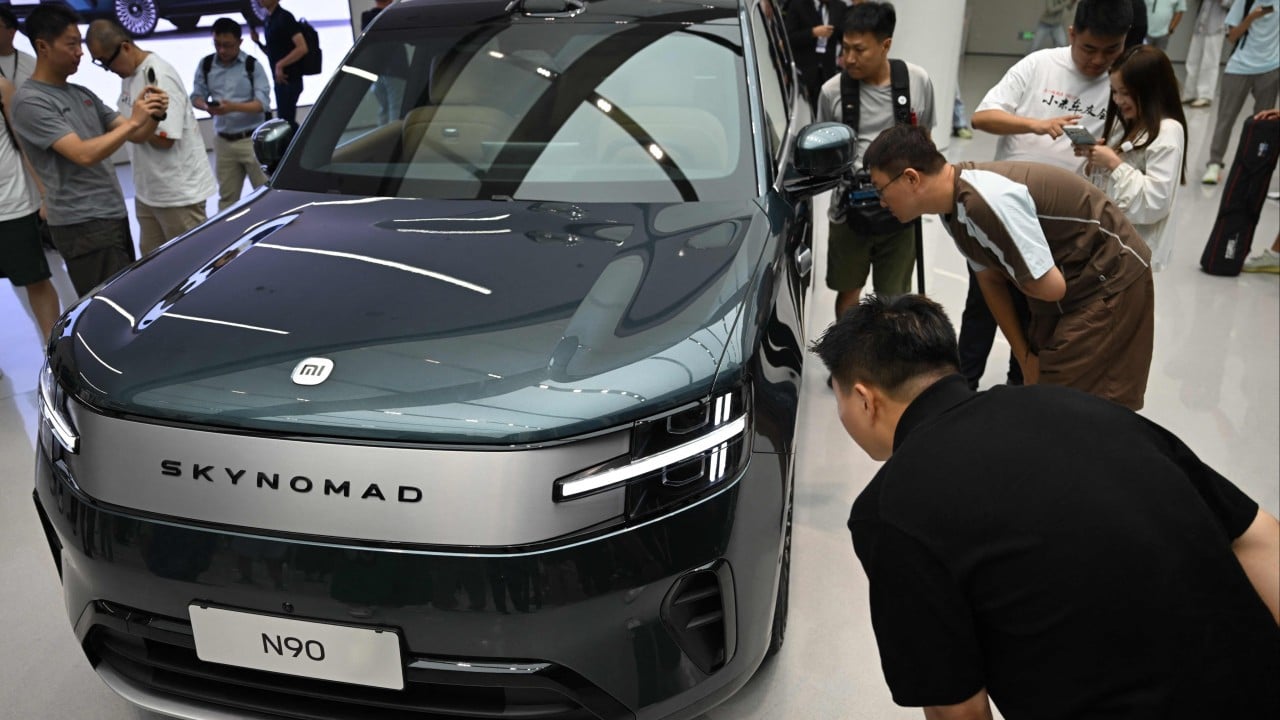
Deutsche Bank further reduced its full-year forecast to 490,000 units, citing delayed delivery of the SkyNomad SUV introduced in late July. Rising component costs reduced Xiaomi's gross profit margin for EVs to 19.2 per cent in the April-June period, down from 26.4 per cent a year earlier, while average selling prices fell by 9.5 per cent year on year to 229,312 yuan per unit.
Smartphones, Xiaomi's primary revenue source, saw a 7.5 per cent year-on-year decline in revenue to 42.1 billion yuan, as did home appliance and internet-of-things products, which decreased by 19.2 per cent to 31.3 billion yuan.
Written by urgent.news from SCMP Tech's reporting — not their text. Machine-written — may contain errors; check the original before relying on it.
This story
This is one outlet's version. Read the fullest account.