Why Gen Z Is Learning to Paint Like 19th-Century Artists
Paint groups are popping up in parks. Art schools are seeing a surge in applications. The rise of A.I. has people turning to more traditional art forms
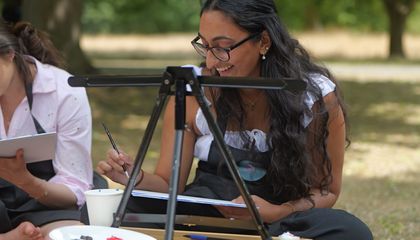
In London’s Hyde Park, young painters are gathering behind wooden easels, putting down their sneakers and baseball caps to focus on their canvas. Patrice-Rose McLean, the founder of Ambient Art London, observes an increasing number of young adults participating in the group’s mobile art events. She attributes this trend to the desire for simpler, more meaningful experiences and connections to nature in an age dominated by artificial intelligence.
Generations Z and Millennials are embracing the 19th-century practice of plein air painting, setting up their easels outdoors to capture moments in time with paint rather than pixels. Art schools in New York are witnessing a surge in applications, with Pratt Institute experiencing a waitlist for its painting and drawing classes.
Plein air painting has also gained popularity on social media platforms like TikTok, where artists post timelapses of their work and share tips on creating their own easels from recycled materials. Remington Robinson, a 40-year-old mural painter and TikTok artist, credits plein air painting for providing a form of meditation and teaching patience.
The technique also allows him to observe subtle nuances in color and experience the environment more deeply. Art historian Clare Willsdon notes a correlation between the current trend and the 19th-century Arts and Crafts movement, which emerged as a response to industrialization. She believes that setting up an easel in nature helps embrace the seasons and rhythms of life.
Kim Tay, co-founder of the Artling gallery in Singapore, echoes this sentiment, emphasizing the need to reconnect with human experiences amidst technological advancements. The return to traditional art forms during the rise of AI has also seen a resurgence in figure drawing, as people appreciate the unique qualities of creating something with their own hands.
Written by urgent.news from Smithsonian's reporting — not their text. Machine-written — may contain errors; check the original before relying on it.