These fish may live for centuries
Researchers have found evidence that lake sturgeon may routinely live well beyond 200 years, with some approaching 300 years.
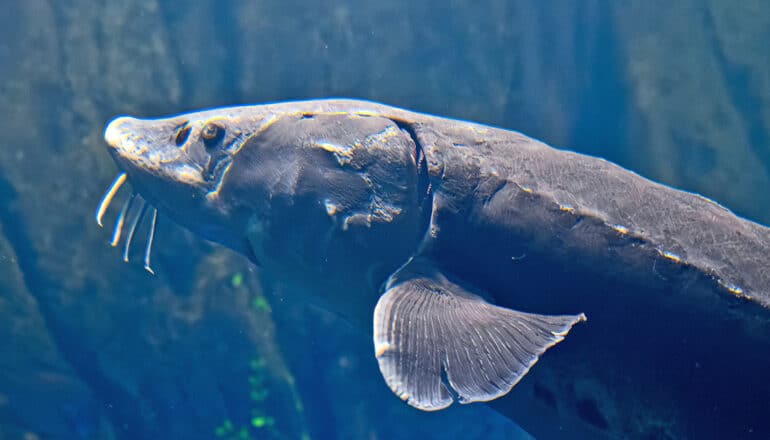
Researchers have discovered that lake sturgeon, a species of freshwater fish found in North America, may live for hundreds of years, with some individuals potentially reaching the age of 300 years. This finding significantly surpasses the previous belief held by scientists that these fish only live up to 200 years. The surprising conclusion was reached by a team from Michigan Department of Natural Resources and Michigan State University, suggesting that the age of these ancient fish has been underestimated for quite some time.
Scott Colborne, an assistant professor in Michigan State University’s fisheries and wildlife department, stated that while scientists have acknowledged the long lifespan of lake sturgeon, the new study highlights that they may live far beyond what was previously thought. Traditionally, researchers estimated the age of lake sturgeon by counting growth rings in their fin spines, but they suspected that the rings in older fish became increasingly difficult to interpret, leading to possible underestimation of their age.
To validate their hypothesis, Colborne and his colleagues analyzed extensive growth records from tagged lake sturgeon that were repeatedly measured over several years. By employing mathematical models similar to those used for estimating the lifespan of Greenland sharks, they were able to develop a more accurate picture of the slow growth patterns displayed by these ancient fish throughout their lives.
These findings have crucial implications for conservation efforts, as lake sturgeon mature slowly, reproduce infrequently, and take decades to replace themselves in the wild. Accurate estimates of their lifespan help scientists better comprehend survival rates, population recovery, and the impact of harvest and habitat restoration.
This discovery emphasizes the importance of long-term conservation and monitoring. The study was made possible by the combined efforts of university researchers, tribal nations, and state partners who dedicated decades to protecting, tagging, and monitoring lake sturgeon across the Great Lakes. Colborne expressed his awe at the discovery, stating that it reinforces the notion that long-term conservation and monitoring are essential for understanding the biology of such species.
An intriguing conversation during the project involved a tribal community member who shared that their ancestors had long believed lake sturgeon could live for up to 400 years. This revelation was particularly impactful, as the modern analytical approach used by the researchers aligned with the traditional knowledge held by Indigenous communities. Colborne described this moment as "a goosebump experience," highlighting the significance of combining scientific research with the wisdom of Indigenous knowledge systems.
While the study suggests that many lake sturgeon live well beyond 200 years, researchers acknowledge that further work is necessary to fully understand the biological mechanisms behind their extraordinary longevity. The findings may also prompt scientists to revise their methods for estimating the age of other long-lived fish species.
This research not only raises new questions about how scientists estimate the age of long-lived fish but also underscores the importance of considering the resilience and adaptability of species like lake sturgeon, which have persisted for millions of years.
Written by urgent.news from Futurity's reporting — not their text. Machine-written — may contain errors; check the original before relying on it.