Inside secret police warehouse as Germany targets small boats gangs
German authorities seize dinghies and life jackets during their first raids under a new law that cracks down on smuggling.
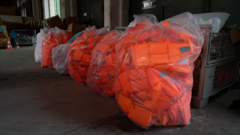
Germany has conducted its inaugural raids under a new law aimed at dismantling smuggling networks utilizing the country as a staging ground for clandestine small boat crossings on the English Channel, according to the BBC. In a coordinated operation involving the UK, France, and Germany in the North Rhine-Westphalia region this spring, authorities seized over 9,000 life jackets, multiple dinghies, engines, and 360 pumps.
These items are currently stored at an undisclosed secret location, with the BBC granted exclusive access. The vessels could have facilitated the illegal migration of more than 2,000 individuals across the Channel, estimated by the UK's National Crime Agency.
Smugglers in western Germany have historically stored equipment in garages or warehouses before transporting it to northern France. However, Berlin's passage of a law in December last year designated facilitating migrant smuggling to the UK as a criminal offense, previously only applicable within the EU's free movement zone. Prior to this, key anti-smuggling laws in Germany had only covered EU nations, not third countries like the UK post-Brexit.
Although previous raids have occurred in Germany, they often depended on French or Belgian warrants.
In 2024, Germany pledged to fortify its laws to facilitate prosecution of those assisting migrants in reaching the UK, as part of a collaborative plan with the UK. The BBC witnessed the aftermath at a concealed police storehouse in western Germany, where the seized goods remained largely untouched. The dinghies, measuring around 9 meters (29 feet), are deflated and primarily stored in cardboard boxes.
In June, the National Crime Agency initially announced the raids, estimating the equipment could have accommodated over 2,000 individuals, averaging around 65 per dinghy. This figure is lower than recent mega dinghies but consistent with the increasing trend of passenger numbers. Experts suggest the emergence of these larger vessels might be linked to intensified enforcement, as smugglers adapt by maximizing cargo capacity when supply lines are disrupted.
The life jackets in the warehouse are tightly bundled and wrapped in plastic, containing minimal padding, deemed insufficient for the unpredictable waters of the English Channel. Most of the equipment utilized for small boats is reportedly manufactured in China before being transported to Europe, often via Turkey. Turkish border customs uncovered 20 unreported inflatable dinghies concealed among mattress pads from a Turkish-Bulgarian border checkpoint, with the driver en route to Germany.
British investigators suspect Kurdish criminal networks wield significant control over the small boats trade in western Germany. A German official noted that gangs operate within Germany due to the presence of many locals. Western Germany is also strategically situated near more heavily monitored French beaches, where migrant boats typically depart.
Local prosecutors caution that while Germany's amended legal provision is still untested, it will compel police to investigate suspicious activities. Legal expert Bernhard Schmeilzl, specializing in UK-German law, asserts that while the legal framework remains largely unchanged since Brexit, it will likely compel German law enforcement to prioritize domestic matters.
Authorities and migrant sources indicate that gangs are facing increased pressure across Europe, including within Germany. Despite a projected decline in channel crossings this year, illegal entries into Europe have also been decreasing. The UK Home Office attributes this reduction to efforts in interrupting the supply of boats to criminal networks and enhancing law enforcement presence on French beaches.
However, opposition parties attribute the decline to adverse weather conditions rather than government actions.
Written by urgent.news from BBC News's reporting — not their text. Machine-written — may contain errors; check the original before relying on it.