Exercise Rotor Clap III and Mission Sudarshan Chakra: Options for Pakistan
India is trying to establish a defensive shield against airborne objects, from drones to missiles.
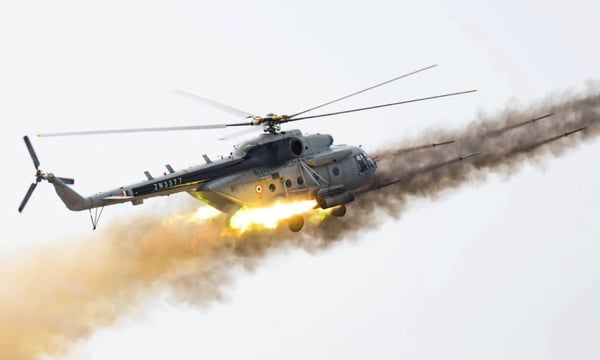
The Indian Air Force (IAF) concluded Exercise Rotor Clap III on August 2 at the Pokhran firing range in Rajasthan. This drill aimed to validate the concept of shooting down unwarranted low-flying loitering munitions and drones. The exercise is a response to the loopholes exposed during Operation Sindoor, particularly the incursion of Pakistani drones into Indian territory.
This development could have serious implications for Pakistan, as it aligns with India's goal to establish a defensive shield against airborne objects through Mission Sudarshan Chakra.
Rotor Clap III marked the third iteration of the drill, following the launch of Operation Sindoor in May 2025. The exercise involved rotary-wing platforms from the IAF fleet, including Apache, Prachand, Mi-25/35P, Rudra, and Mi-17V-5 helicopters. These helicopters were deployed at forward operational bases in Rajasthan, bordering Pakistan, to take advantage of their capability to fly low and evade low-level radars.
Rotor Clap III is part of IAF's attempt to test and validate new warfighting tactics, techniques, and procedures, with a focus on shooting down slow-moving airborne targets. The exercise highlights the potential for helicopters, such as the Prachand and Apache, to serve as a key component of Mission Sudharshan Chakra's airborne leg. The IAF's focus on low-flying platforms aligns with India's strategic partnership with Israel, as Israel has assisted the IAF in enhancing its warfighting tactics in the past.
The future of the IAF's helicopter fleet includes 156 additional units, with 66 to be inducted into the IAF's fleet and 90 to the Indian Army's fleet, set to be delivered by 2032. These helicopters, such as the indigenously developed Prachand and the Rudra attack helicopter, will be used for drone interdiction missions. While rotary platforms may not be as cost-effective as ground-based air defense systems, they are a less expensive alternative to missile interceptors.
Pakistan faces the challenge of countering India's evolving tactics. To do so, Pakistan should consider acquiring high-speed loitering munitions with speeds exceeding Mach 0.5, as this will make it difficult for helicopter-based interdiction by the IAF. Additionally, closing the low-level radar detection gap by deploying advanced long-range electro-optical sensors can help Pakistan engage Indian rotary platforms that may come close to the border.
Written by urgent.news from The Diplomat's reporting — not their text. Machine-written — may contain errors; check the original before relying on it.