Even Near a Supermassive Black Hole, Stars Enrich the Interstellar Medium
Astronomers know that evolved AGB stars shed their outer layers, contributing to the makeup of the interstellar medium. But new JWST observations show this can happen even near a supermassive black hole, where powerful radiation could obliterate molecules.
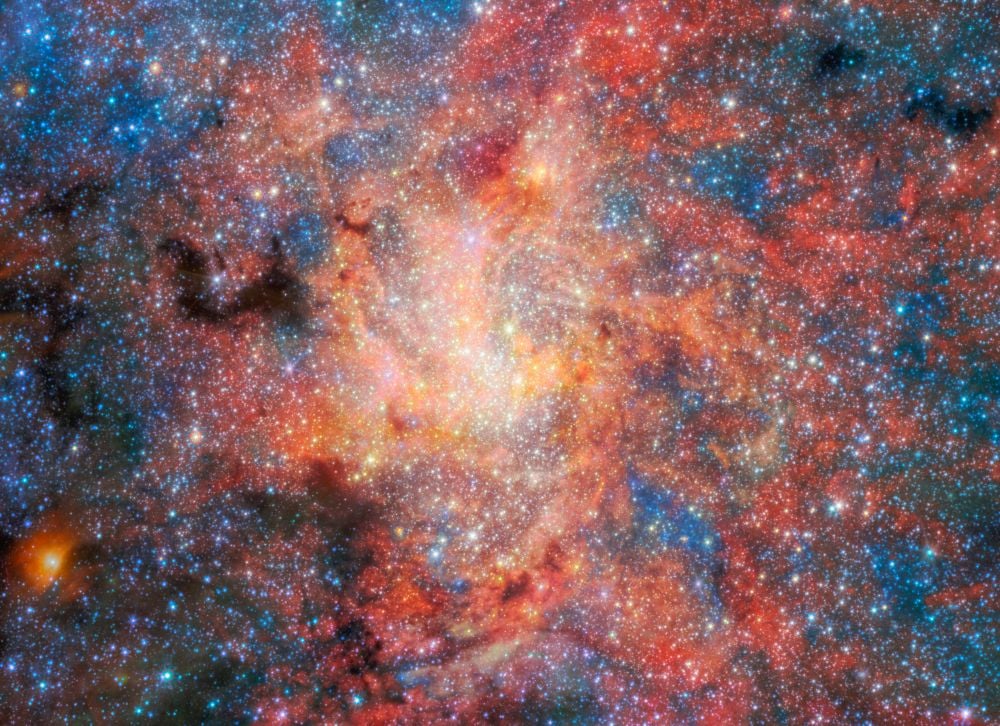
In the Milky Way's galactic center, dominated by the supermassive black hole Sagittarius A-star (Sgr. A*), astronomers have discovered that stars can enrich the interstellar medium (ISM) despite the intense radiation. The star IRS 3, located only 0.55 light years from Sgr. A*, is a highly-evolved AGB star with 6 solar masses and is 72 million years old.
Despite the overwhelming radiation, water, dust, and alumina-amorphous silicate compounds have been found around IRS 3, which was shed from the star during its AGB phase. This finding, published in Astronomy and Astrophysics, reveals how stars can continue to contribute material to the ISM even in the harshest environments, such as the center of our galaxy.
Written by urgent.news from Universe Today's reporting — not their text. Machine-written — may contain errors; check the original before relying on it.