Colombia’s Israel Policy Shift Over Golan Heights Risks Isolation
Colombia’s Israel policy changed sharply after President De la Espriella’s new government formally recognized Israeli sovereignty over the Golan Heights and moved Colombia’s embassy from Tel Aviv to Jerusalem. The decisions reversed the foreign policy stance that former President Gustavo Petro built around explicit support for the Palestinian cause and placed Colombia alongside a small […]
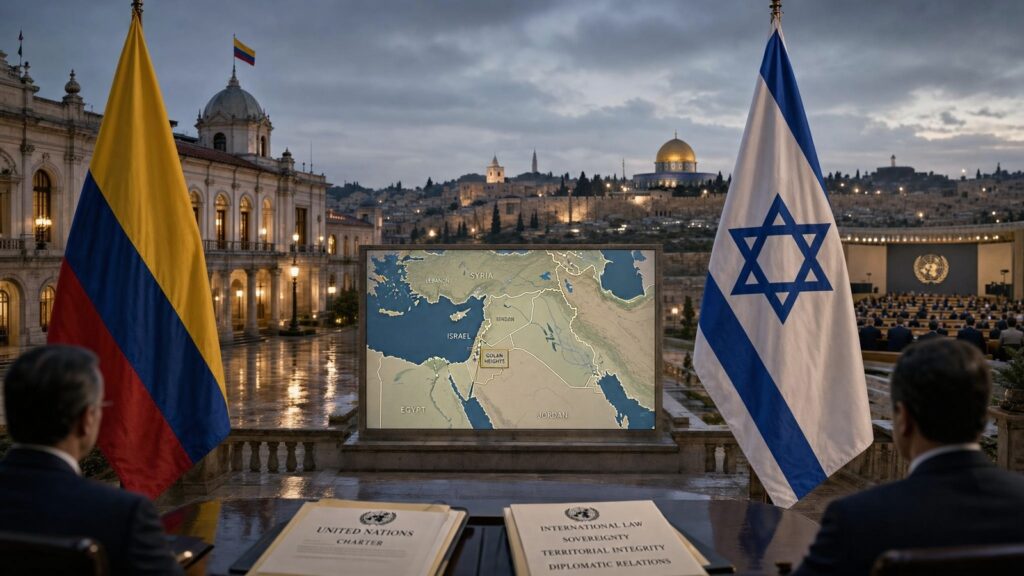
Colombia has recently altered its Israel policy in response to the Golan Heights and Jerusalem issues, potentially leading to diplomatic isolation. President De la Espriella's administration officially acknowledged Israeli sovereignty over the Golan Heights and relocated Colombia's embassy from Tel Aviv to Jerusalem. These decisions mark a drastic departure from former President Gustavo Petro's stance, which strongly backed the Palestinian cause.
Following this shift, Colombia now stands with only the United States in recognizing Israeli control over the Golan Heights. Foreign Minister Omar Bula stated that recognizing the territory's continued Israeli control is crucial for national defense, echoing Israel's own justification for its 1981 annexation. Colombia joins the list of nations that recognize Israeli sovereignty over the territory, despite the United Nations Security Council's declaration that the annexation is null and void under international law.
Middle East affairs specialist Angelica Alba-Cuellar noted that this move isolates Colombia from the international consensus and raises questions about the country's commitment to territorial sovereignty and international law. In addition to these actions, Colombia plans to withdraw its support for the International Court of Justice case accusing Israel of war crimes in Gaza.
This further demonstrates the country's evolving foreign policy landscape. By establishing a diplomatic mission in Jerusalem, Colombia aligns itself with just eight states globally that maintain embassies there, alongside the United States, Guatemala, Kosovo, Honduras, Paraguay, Papua New Guinea, Fiji, and Somaliland. The status of Jerusalem remains a contentious issue in the Israeli-Palestinian conflict due to its religious significance for Muslims, Christians, and Jews, as well as the fact that the United Nations never recognized Israel's 1980 annexation of the city's eastern part.
Colombia's recognition of Jerusalem as Israel's capital, rather than maintaining an embassy in Tel Aviv, is seen as a de facto acceptance of Jerusalem as Israel's capital, contradicting international law. This decision, along with the Golan Heights recognition, puts Colombia in a position where it stands alongside the United States as the only two countries worldwide that accept Israeli sovereignty over territory still classified as occupied Syrian land by the international community.
The Arab League and several countries, including Egypt, Qatar, Turkey, Saudi Arabia, and Syria itself, have already rejected Bula's declaration, creating visible tension between Colombia and the Arab world. Alba-Cuellar warns that this pattern could eventually complicate Colombia's arguments if a foreign power ever threatened its sovereignty or territorial integrity, as the country has already compromised its moral and legal standing on that issue.
While there are no immediate formal international sanctions expected, verbal condemnations and lingering doubts about Colombia's commitment to international law are anticipated. Colombia and Israel have maintained a longstanding defense relationship that includes Kfir fighter jets, Galil rifles, and counterterrorism cooperation.
These ties, which predate the recent realignment, become more relevant under the new government's rhetoric. However, Alba-Cuellar does not foresee formal sanctions targeting Colombia's economic interests. Instead, she predicts verbal condemnations and doubts about Colombia's commitment to international law, with the potential to affect Saudi and Emirati investment in Colombia's industrial, mining, and technology sectors. These economic relationships usually persist beyond short-term political disputes.
Written by urgent.news from Colombia One's reporting — not their text. Machine-written — may contain errors; check the original before relying on it.