Beyond Oil: Record Revenue & U.S. Direct-Sales Expansion Fuel Scaling Phase – Quarterly Update Report
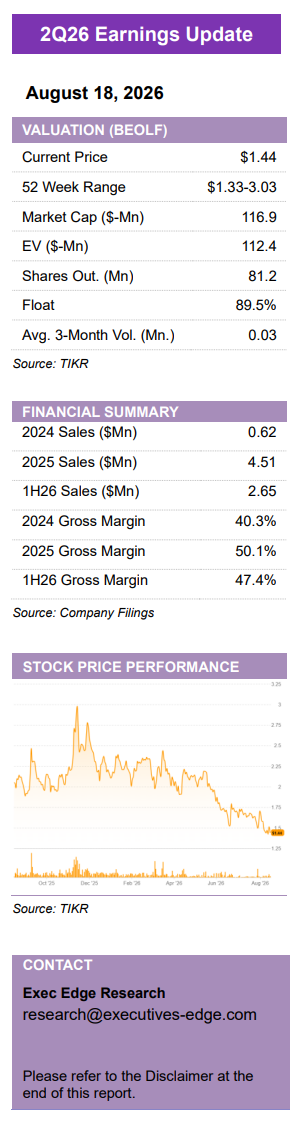
In the second quarter of 2026, BOIL reported record revenue of $1.4 million, a 28% increase year-over-year from $1.1 million and an 11% increase sequentially from $1.3 million. This marks a notable acceleration from the ~1% sequential growth reported in the previous quarter. The first-half of 2026 saw revenue reach $2.65 million, a 26% increase from $2.1 million in the same period of 2025.
This growth lifts BOIL's annualized revenue run-rate to approximately $5.6 million, up from roughly $5.0 million at the beginning of the year.
Gross margin declined to 42.2% in the second quarter, down from 53.1% in the previous quarter and 56.3% in 2Q25, reflecting increased costs associated with rollout, inventory, and channel transitions. These costs include early U.S. customer servicing expenses and expansion into new markets. Despite this, the company remains focused on broadening its commercial infrastructure, with 100+ validated locations and thousands of potential customer sites.
BOIL's commercial traction is broadening across supermarket, fast-food, and casual dining sectors, providing multiple avenues for scaling recurring U.S. revenue.
Recent progress includes supermarket, fast-food, and premium casual-dining customers, alongside distribution through Sysco Los Angeles, expanding BOIL's base of multi-site commercial activity. Product validation spans over 100 U.S. locations, with several relationships transitioning from pilots to paid deployments and broader rollouts.
Notably, three large food operators collectively representing thousands of potential locations have moved beyond pilot activity into paid deployment. The company has also streamlined its distributor portfolio, discontinuing agreements with Latitude in the U.S. and Ukraine, and T&J Oil in Australia, while transitioning a relationship with Deep Frying Solutions in India to a non-exclusive structure.
Distribution remains crucial, with 25 distributors covering more than 50 countries, but is increasingly seen as a complement to direct selling for tier-one accounts. The hybrid approach is expected to provide BOIL greater control over pricing, implementation, and recurring customer economics for key accounts, while continuing to use distributors for local logistics, smaller customers, and regions where direct infrastructure would be less efficient.
Strategic relationships are shifting from initial validation to paid deployment and broader multi-site rollouts, indicating early progress towards recurring commercial usage. BOIL's focus on expanding commercial traction, shifting commercial KPIs towards location expansion, repeat orders, and recurring consumption, and growing direct U.S. work signals a move deeper into the revenue-execution phase.
Written by urgent.news from Yahoo Finance's reporting — not their text. Machine-written — may contain errors; check the original before relying on it.