'Beyond human intuition': AI designs chip components 500 times smaller than what engineers could ever imagine
Three new AI-designed chip components are just a few micrometers long and go beyond what human engineers have previously envisaged.
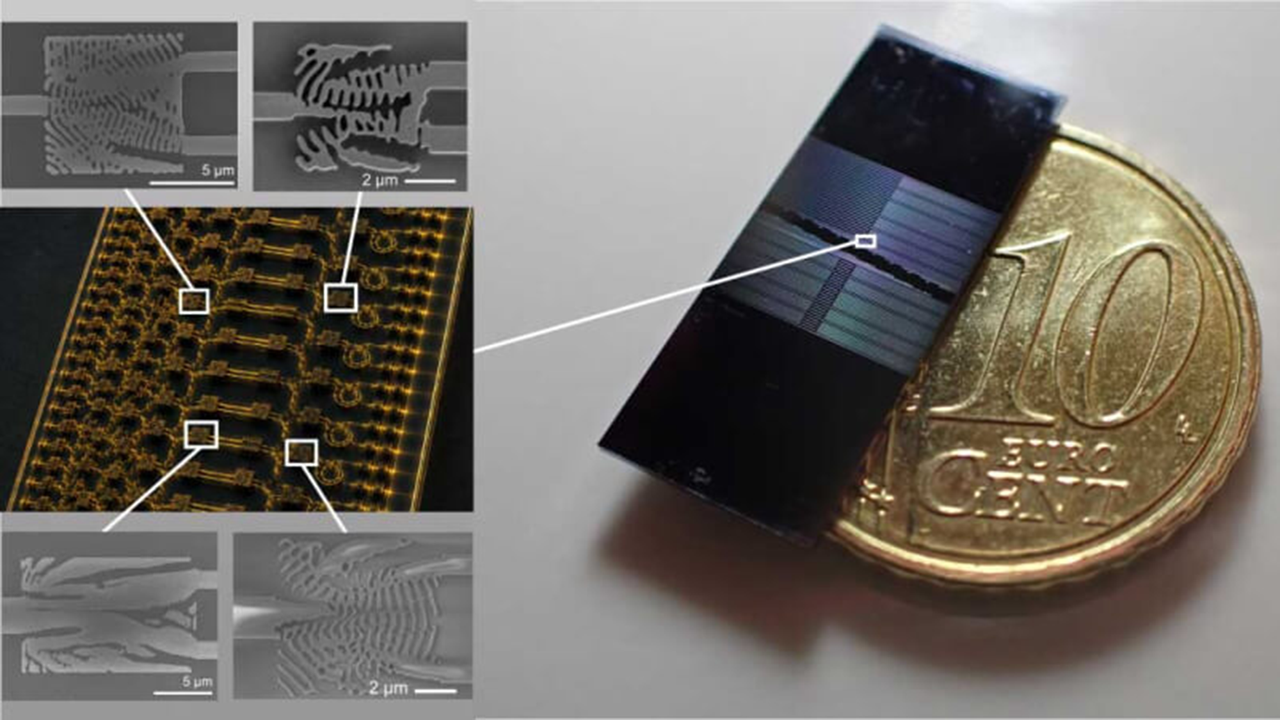
Photonic microchips, the size of a penny, have been revolutionized by artificial intelligence (AI) that has produced components 500 times smaller than previously possible. In a study published in Nature Communications on May 28, scientists demonstrated how AI-generated designs for three key components – wavelength splitters, mode sorters, and mirrors – could be integrated into photonic circuits.
Unlike electronic chips that use electrons, photonic chips transmit information via light particles, resulting in faster data processing, higher bandwidth, and lower energy loss. Photonic chips are crucial for applications like fiber-optic communications, data centers, AI, lidar for self-driving cars, and quantum computing.
The AI algorithm began with a clear understanding of the components' desired functions and manufacturing constraints, then worked backward to create intricate nanostructures. This "inverse design" approach often produced designs that would not have been conceived by human engineers. The resulting components, made from thicker silicon nitride to minimize light loss, showcased high performance, with mirrors reflecting up to 98.5% of incoming light.
While these AI-designed components represent a significant step forward, the researchers have not yet integrated them into a complete, functional photonic chip. Future work will focus on combining these components to unlock new functionalities and push the boundaries of compact, high-performance photonic systems.
Written by urgent.news from Live Science's reporting — not their text. Machine-written — may contain errors; check the original before relying on it.