A Quantum Trick for Spotting Gravitational Waves
Gravitational wave astronomy has seen plenty of improvements since the original signal was captured in 2015. Despite that, it remains an engineering challenge to actually create the detectors needed for the precise measurements that gravitational waves require. A new NASA Institute for Advanced Concepts (NIAC) grant is funding a concept from a team led by Paul Stankus at Brookhaven National…
Gravitational wave astronomy has experienced significant advancements since the initial detection in 2015. However, constructing detectors for these elusive waves remains a formidable engineering challenge. NASA's Institute for Advanced Concepts (NIAC) has allocated funding to a proposal by a team led by Paul Stankus at Brookhaven National Laboratory, which could address some of these obstacles through the application of quantum mechanics.
Gravitational wave detectors are categorized into two primary types: ground-based detectors, like LIGO, which can pick up relatively high-frequency waves generated by stellar mass black holes and neutron star collisions; and Pulsar Timing Arrays (PTAs), which detect minute hums by monitoring the timing of dead spinning stars over extended periods.
An emerging entrant, LISA, is a space-based interferometer capable of detecting milli-Hertz waves from supermassive black hole mergers. Despite LISA's potential, a substantial gap in sensitivity remains between it and the PTAs, spanning roughly micro-Hertz frequencies. Space-based interferometers like LISA are theoretically capable of reaching this level of sensitivity but are fraught with engineering difficulties.
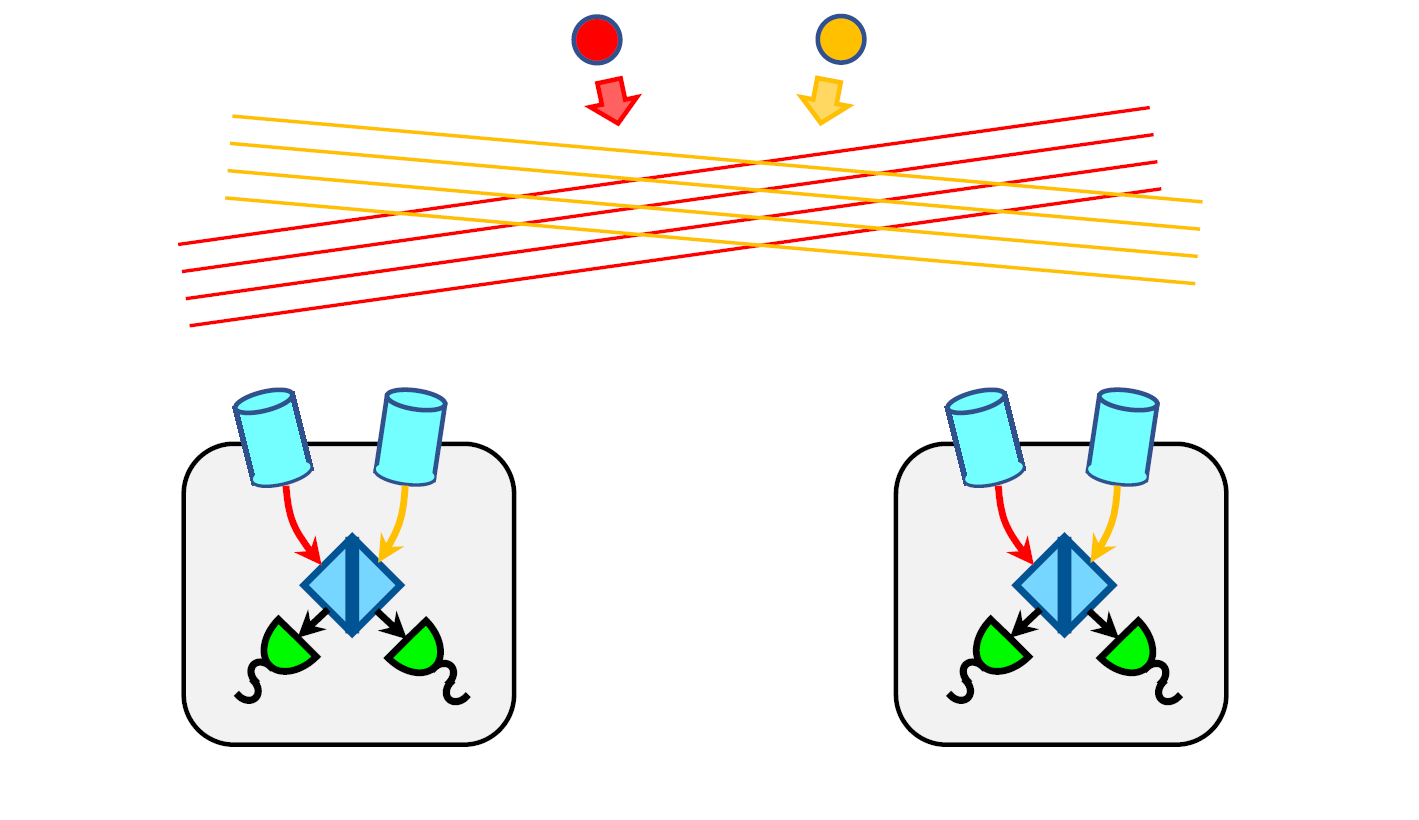
Interferometers usually necessitate a physical or optical connection, usually a laser beam, which has to bounce off extremely precisely floating mirrors millions of kilometers apart. Maintaining a flawless, continuous physical laser link over such distances is an insurmountable challenge. The proposed solution by Stankus' team eliminates the need for a laser link altogether by focusing on the astrometric signature of gravitational waves – essentially, watching stars wobble slightly as the waves pass through our solar system.
To accomplish this, they propose using quantum phenomena, specifically a "two-photon amplitude interferometer" based on the Hanbury Brown and Twiss (HBT) effect. The team plans to launch two independent spacecraft in free-fall orbits, neither of which requires a physical connection. Both spacecraft will monitor the same set of stars, recording precise timestamps and photon counts via ultra-fast single-photon detectors.
The Earth-based data will then be analyzed by supercomputers, which will identify correlations, or "quantum bunching", in the photon arrivals, allowing the calculation of phase interference without the photons ever physically touching each other. Any shift in phase would indicate a wobble in the star's apparent position, signaling the presence of a gravitational wave.
While the concept may seem like science fiction, the team has already developed a working tabletop prototype, as demonstrated in a 2023 paper. Over the next nine months, funded by NIAC, the team aims to prove the scalability of their technology for use in satellites in space. If successful, their approach could revolutionize our understanding of some of the universe's most profound mysteries.
Written by urgent.news from Universe Today's reporting — not their text. Machine-written — may contain errors; check the original before relying on it.