What Can We Actually Find on an Exoplanet? Part 1: The Atmospheric Fingerprint
If an alien civilization could see Earth only as a single pale blue dot, what could they learn? We start with transit spectroscopy, the biosignature cocktail of oxygen, methane, ozone, and water, and why even the James Webb will struggle to find life.
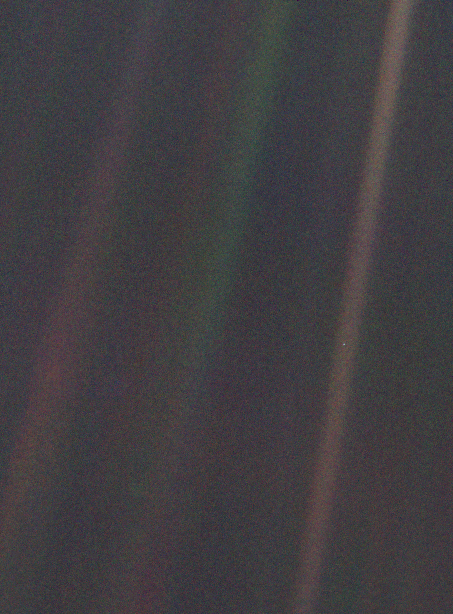
In 1990, the Voyager 1 spacecraft captured an iconic image of Earth, a single pale blue dot suspended in space. Scientists are now pondering what we might discern about life on distant exoplanets using just that one pixel of light. By employing a technique called transit spectroscopy, researchers analyze the starlight that passes through a planet's atmosphere during a transit to identify atmospheric molecules.
Every molecule absorbs specific wavelengths of light, creating a unique spectral fingerprint. Comparing the star's light with and without the planet reveals these atmospheric signatures.
The challenge lies in the minuscule signal, which is currently detectable by instruments like the James Webb Space Telescope. However, the telescope's capability is limited, only able to reliably detect signals of around 10 parts per million. This means that detecting a biosignature on an Earth-like planet around a Sun-like star is challenging. While the telescope might be pointing at a living world, the faint signals could be indistinguishable from background noise.
The James Webb's most promising scenario involves a rocky planet orbiting a small red dwarf star, which is significantly dimmer than our Sun. The planet's atmosphere would block a larger fraction of the star's light, enhancing the faint biosignature signal. However, discovering such a system is rare, and even then, there is only a slim chance of identifying a habitable world.
In conclusion, while the prospect of discovering life on distant planets is intriguing, the current technology may not be sufficient to definitively confirm the presence of extraterrestrial life.
Written by urgent.news from Universe Today's reporting — not their text. Machine-written — may contain errors; check the original before relying on it.