Solana’s Local Fee Markets Reveal the Limits of TPS as a Metric
Why Solana's local fee markets matter more than TPS for managing congestion, improving fee efficiency, and designing scalable blockchain applications.
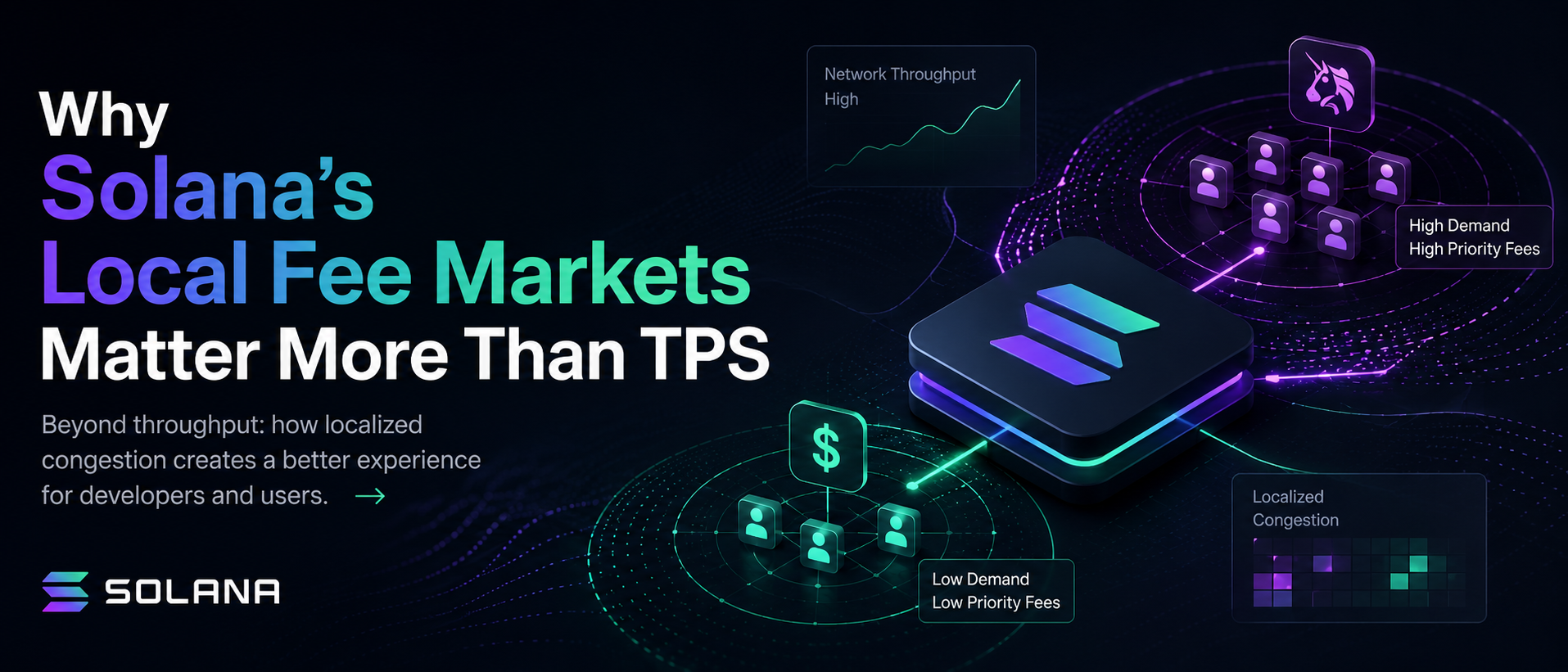
Solana's transaction processing speed is commonly measured in transactions per second (TPS). However, this metric alone does not fully capture the experience of application developers, particularly when a single, popular application experiences sudden spikes in demand. This is where Solana's local fee markets come into play, providing a more nuanced understanding of network congestion.
The issue with treating blockspace as a single market is that it fails to account for the fact that different applications contend for distinct sets of state. For example, a heavily used DeFi protocol and a simple USDC transfer transaction could both cause congestion, but only the DeFi protocol transaction would be affected by increased fees.
Solana's account-based execution model allows the network to make congestion local, by explicitly identifying which accounts a transaction reads from and writes to. This enables the runtime to determine which transactions can execute concurrently, and which ones conflict over state. Consequently, a transaction that competes for the same state as a popular application's transactions will experience higher fees, while unrelated transactions will remain unaffected.
The key insight here is that congestion can be localized to specific application states. Solana's fee model consists of a base fee and an optional prioritization fee. The prioritization fee increases the likelihood of the transaction being scheduled by the current leader, but it is targeted towards transactions that compete for the same state.
Developers can optimize their transaction fees by specifying a compute-unit limit and a price per compute unit. This allows them to balance cost and performance, taking into account the compute resources required for their transactions. By thinking about congestion in terms of specific application states rather than global TPS, developers can make more informed decisions about how to design their applications and manage resource usage.
However, local fee markets are not a panacea for scalability issues. If multiple users attempt to modify the same state, that state remains a bottleneck, regardless of fee optimization. Therefore, state design becomes a critical aspect of overall performance, and efficient account layout is essential for scalability.
In summary, Solana's local fee markets offer a more precise way to understand network congestion and its impact on application performance. By focusing on specific application states rather than global TPS, developers can design their applications more effectively and make informed decisions about resource allocation, ultimately leading to better user experiences even during periods of high demand.
Written by urgent.news from HackerNoon's reporting — not their text. Machine-written — may contain errors; check the original before relying on it.