Scientists find dead star that predicts our sun's future: 'Broken apart and returned to the galaxy'
A composite image of data from the Hubble Space Telescope, the Kitt Peak four-meter telescope and MOTHRA reveal the Helix Nebula. We can see the bow shocks, particularly on the left.
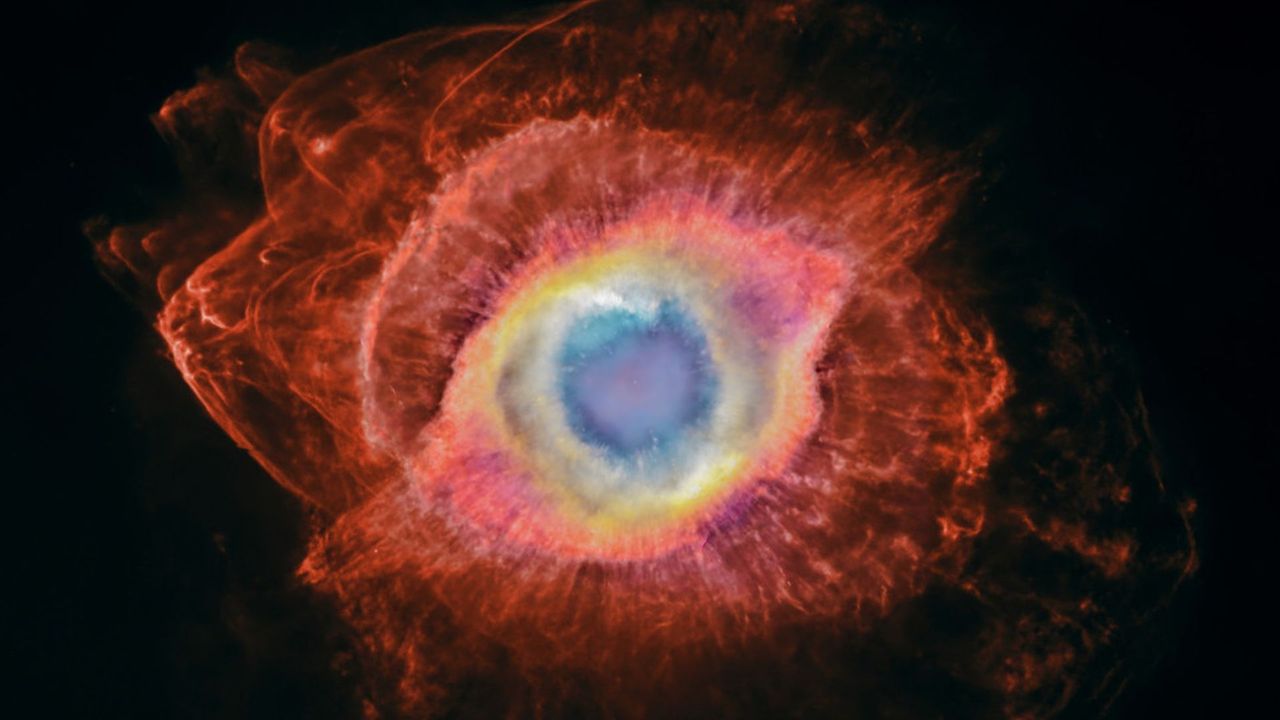
Astronomers have observed a dead star, known as the Helix Nebula, recycling its remains back into the galaxy, completing the life cycle of the star. Stars, including sun-like ones, have finite lifespans and ultimately transform into planetary nebulae when they run out of hydrogen for nuclear fusion. The Helix Nebula, located 650 light-years away in the constellation of Aquarius, is an example of this phenomenon.
The central star of the Helix Nebula exhausted its hydrogen supply, causing it to contract and form a red giant. Eventually, the outer layers detached and dispersed into space, forming the Helix Nebula itself. Meanwhile, the inert core contracted and became a white dwarf. As the nebula expands, it releases material into the interstellar medium (ISM), enriching it with elements produced during the star's life.
These elements will eventually contribute to the formation of new stars, planets, and potentially life in the future.
However, observing the moment when a dead star's remains are absorbed into the ISM has been difficult until now. Yale University's Pieter van Dokkum and his team were conducting routine calibration of a new astronomical instrument called MOTHRA when they unexpectedly discovered a network of bow-shaped structures in the outer halo of the Helix Nebula.
These structures, or bow shocks, result from the interaction between the expanding nebula and the interstellar gas, similar to the waves created when a boat moves through water.
The team found 22 complete or partial arc-shaped clumps of gas in the outer halo, which change in size and structure as they move further from the central star. This progression suggests that the clumps press into the ISM and become eroded over time, eventually dispersing back into the interstellar gas after about 10,000 years. This observation provides evidence that elements from the planetary nebula are being returned to the galaxy, enriching it and contributing to future generations of stars, planets, and potentially life.
The findings were published in the journal Nature, highlighting the ongoing cycle of stellar evolution and the continuous enrichment of the Milky Way with elements produced by previous generations of stars.
Written by urgent.news from Space.com's reporting — not their text. Machine-written — may contain errors; check the original before relying on it.