Scientists find 3 supermassive black holes on the verge of collision inside a distant galaxy
A greedy galaxy that existed less than 1.3 billion years after the Big Bang is hoarding supermassive black holes.
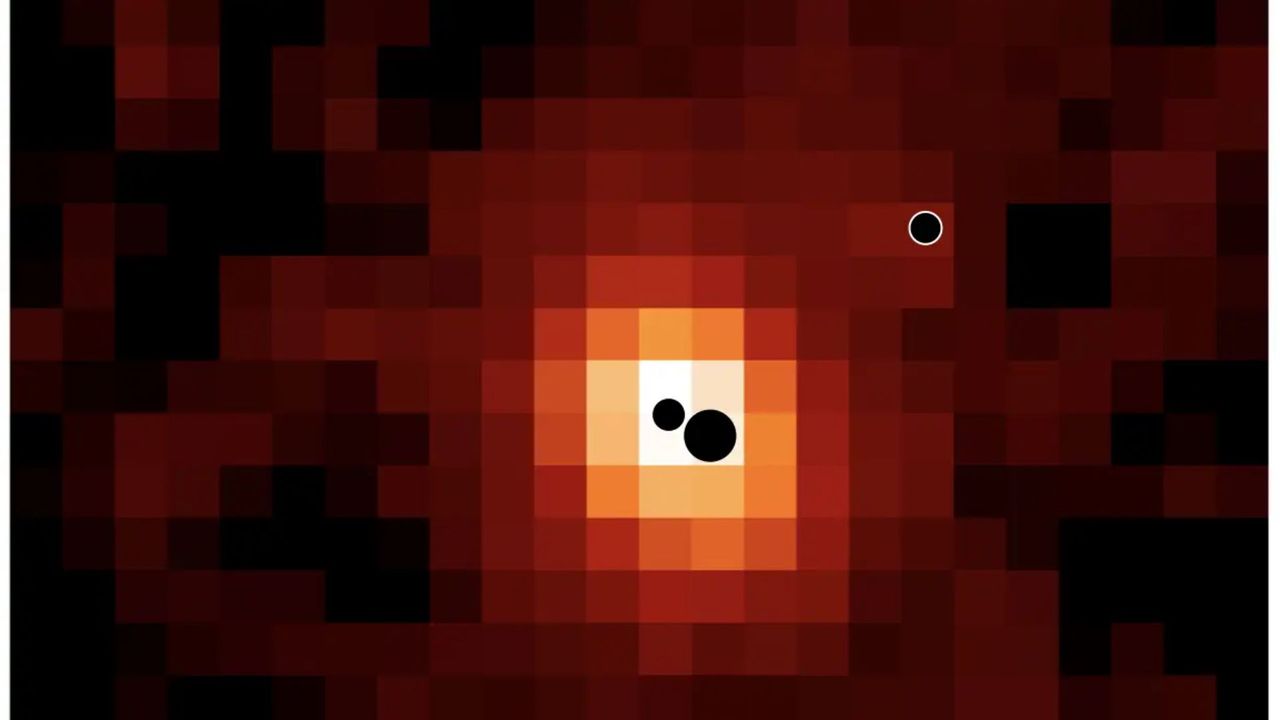
Three colossal black holes are nearing a collision within a distant galaxy, potentially merging to form an even larger entity. Astronomers discovered these black holes in galaxy J0148-4214, observed through the James Webb Space Telescope (JWST) nearly 12.5 billion years ago, as it appeared shortly after the Big Bang. The study, led by Hannah Übler from the Max Planck Institute for Extraterrestrial Physics, reveals the first evidence of three active black holes within a single galaxy in the distant universe.
This discovery supports the notion that efficient processes in the early universe facilitated the rapid merging of massive black holes, paving the way for future gravitational-wave detections by advanced observatories.
J0148-4214, catalogued and distant with a redshift of 5.0167, is too far away for the JWST to directly view the black holes. However, by measuring the velocity of hydrogen gas in their accretion disks, scientists identified the black holes' masses, accretion rates, and the galaxy's stellar mass, amounting to about 1.3 billion solar masses.
Two of the black holes, located at the galaxy's center, have masses of 80 million and 600,000 solar masses, respectively. The smaller, more active black hole is growing rapidly by accreting gas at a rate exceeding the Eddington limit, its theoretical maximum feeding capacity. This extreme growth rate is likely to persist only briefly before feedback halts its expansion.
The third black hole, 5,500 light-years from the center, is twice as massive as our Sun and is thought to have joined the galaxy via galactic mergers. However, its fate remains uncertain; it might merge with the other two or escape the galaxy altogether, as the three-body problem complicates predicting its path. This research, published in Astronomy & Astrophysics, highlights the potential for black hole mergers as a rapid growth mechanism for supermassive black holes in the early universe, paving the way for future gravitational wave detections by the European Space Agency's LISA space-based detector.
Written by urgent.news from Space.com's reporting — not their text. Machine-written — may contain errors; check the original before relying on it.