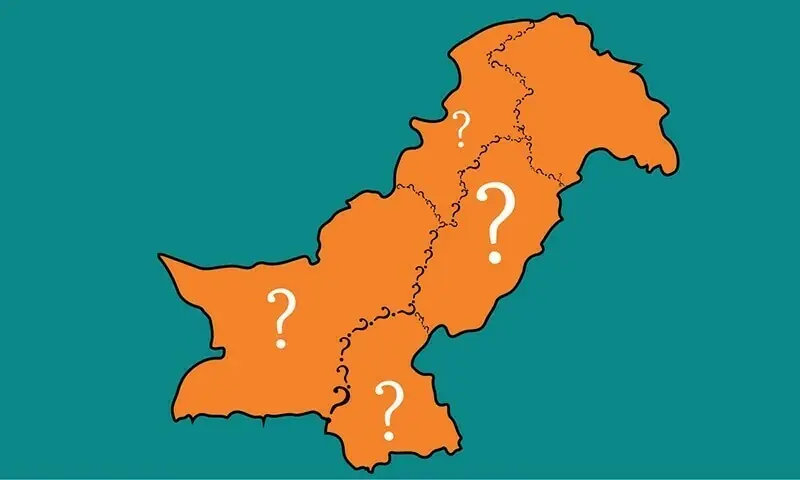
More provinces? Let the people decide
The evolution of provincial alteration in British India began with the Regulating Act of 1773, after which the colonial state repeatedly altered India for its own purposes. The process culminated in the Government of India Act, 1935, which introduced provincial autonomy and proposed the creation of a Federation of India — and, in turn, shaped the constitutions of both India and Pakistan. In 1947,…
The transformation of provincial administration within British India began with the Regulating Act of 1773, and the colonial state continued to modify India for its own interests. The Government of India Act, 1935, introduced the concept of provincial autonomy and anticipated the formation of a unified India, which laid the foundation for the constitutions of both nations.
Upon independence in 1947, India and Pakistan inherited provinces that had been established, modified, subdivided, and renamed under colonial rule. Both nations faced a critical question: should their internal state boundaries adhere to colonial arrangements or be redrawn to better align with the linguistic, cultural, geographical, and administrative realities of their respective peoples?
India opted to allow the union to reshape its internal geography without compromising the unity of the union itself. Article 1 of the Indian Constitution declares India as a union of states, and Articles 2 and 3 grant parliament the authority to create or abolish states, adjust their areas, boundaries, and names. Parliament holds the ultimate power; the affected states have no veto.
The States Reorganisation Commission, established in 1953, submitted its recommendations in 1955, which were implemented through the States Reorganisation Act, 1956, and the 7th Constitutional Amendment. This led to the extensive reorganization of Indian states along linguistic and territorial lines. While British India had 17 provinces at the time of independence, India now boasts 28 states and 8 union territories, which have fortified the union.
Pakistan's trajectory diverges from India's. At the time of independence in 1947, it consisted of five provinces: East Bengal, West Punjab, Sindh, the North-West Frontier Province, and Balochistan (the latter, initially a chief commissioner's province, was later granted full provincial status in 1970). Conversely, where India accommodated linguistic diversity by forming smaller states, Pakistan consistently centralized, abolished, and then reinstated provincial identities.
In 1955, the One Unit Scheme amalgamated West Punjab, Sindh, the North-West Frontier Province, and Balochistan into a single province, West Pakistan, leaving the country with just two units - East and West - to ensure administrative and political parity between the two wings. However, the One Unit Scheme was inherently flawed, as it suppressed the distinct identities of the four western provinces, leading to deep-seated hostility.
Despite attempts to reverse the decision after fifteen years, the experiment ultimately failed. These counterproductive reversals could not prevent Pakistan's disintegration. Following East Pakistan's secession in 1971, the four western provinces remained the principal constituent units of Pakistan. Article 1 of the 1973 Constitution of Pakistan proclaims that "Pakistan shall be a federal republic," with its territories comprising the provinces of Balochistan, Khyber Pakhtunkhwa, Punjab, and Sindh.
Article 239(4) states that "a bill to amend the Constitution which would have the effect of altering the limits of a province shall not be presented to the President for assent unless it has been passed by the Provincial Assembly of that province by the votes of not less than two-thirds of its total membership." In essence, the article grants the affected state a veto; the federal legislature cannot unilaterally alter provincial boundaries.
Throughout history, provincial boundaries have remained fluid, but constitutional feasibility does not equate to constitutional prudence. The question of altering provincial boundaries hinges on the specifics of the alteration and the disposition of the provincial assemblies. The critical distinction lies in who holds the constitutional authority to redraw a province's map: in India, it is Parliament; in the United States, it is Congress along with the affected state; in the United Kingdom, it is Parliament alone; and in Pakistan, it is a combination of Parliament and the affected provincial assembly.
Compared to India, the process of altering a province in Pakistan is significantly more intricate constitutionally and democratically: the affected state legislature may obstruct the amendment; the constitutional and democratic legitimacy of federal and provincial legislatures is deeply contested here and abroad; the required constitutional and democratic procedures lack transparency and public credibility; political calculations are in play; and one cannot dismiss the possibility of external influence.
Moreover, determining whether subdividing a province serves the national interest and strengthens the federation is contingent upon the specifics of the alteration, as well as the disposition of the provincial assemblies. The arguments for and against smaller provinces resonate throughout federations. Proponents argue that smaller provinces bring government closer to citizens, rectify population imbalances, mitigate economic and developmental disparities, provide direct political representation, safeguard historical and linguistic identities, empower local control over resources, and foster federal stability.
Conversely, critics contend that more provinces necessitate prohibitively high administrative costs, politicize ethnicity, generate new boundary disputes, fragment historic provinces, undermine equal representation in the Senate, and potentially provoke political calculations that weaken the federation. If smaller provinces were to be created, it would be advisable to submit the matter to a national referendum under Article 48(6) of the Constitution, enabling the Pakistani people to decide their own future.
In the event of an affirmative vote, the constitutional provisions could then be invoked to effectuate the subdivision of provinces.
Written by urgent.news from Dawn's reporting — not their text. Machine-written — may contain errors; check the original before relying on it.