Is Your New DevSecOps Tooling Reducing Work Or Just Adding to It?
Security belongs in the software delivery pipeline. The harder question is where, how often and at what cost. Many pipeline teams eventually add security scanning to CI/CD, and relatively few go back afterward to measure what it actually cost the delivery process. Security coverage went up. Something else changed too, and it is rarely measured […]
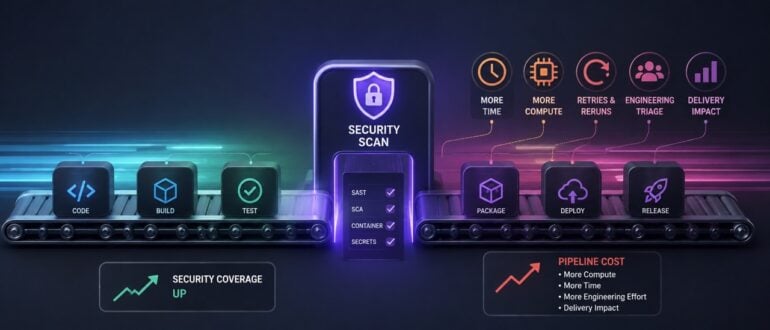
Introducing security into the software delivery pipeline is essential, but determining the optimal placement, frequency, and cost becomes crucial. Many teams simply add security scanning to their CI/CD processes without considering the impact on the delivery process. While security coverage increases, another aspect changes: the cost of running the pipeline.
The concept of "shift left" is often viewed as a free upgrade, catching problems early without downsides. However, this is not always true. Security controls can cost more in terms of pipeline execution time and computing resources, even if they reduce the cost of fixing vulnerabilities. It is important to recognize that security controls, such as SAST, SCA, container scanning, secret scanning, and dependency analysis, all require execution time and can scale with the size of the codebase or dependency count.
These controls generate new work, including triage, false-positive review, and blocked builds, which can lead to retries and re-running earlier pipeline stages. This pattern has been observed in various pipelines: implementing security tooling increases the overall workload, delays artifact production, and raises CI/CD infrastructure costs.
It is crucial to consider what the new security control replaces before adding it. A new SCA tool catching known-vulnerable dependencies may not render existing manual dependency reviews obsolete. Similarly, container scanning and secret scanning may add duplicated engineering effort if they overlap with existing manual checks. To accurately assess the real cost of a new security control, consider the following equation: incremental DevSecOps cost = tool or service cost + additional CI/CD compute + additional execution time + retry and rebuild cost + engineering triage effort + delivery and release impact.
It is essential to include more than just the tool or service cost in the model, as additional factors such as compute consumption, reruns, and time-to-artifact can compound and affect delivery speed. Before adopting a new security control, ask five key questions: 1. What security gap does this control address? 2. What existing control or manual process does it replace entirely or partially?
3. How much pipeline execution time does it add end-to-end? 4. How much additional compute does it consume, and how does that scale with the codebase? 5. What effect does it have on artifact and release throughput? These questions help determine whether the new control provides value and whether its cost is justified. Security tooling is not a poor investment, but measuring the whole delivery system, not just the tracked aspects, is crucial.
A well-implemented DevSecOps approach treats security coverage and delivery speed as interdependent outputs, optimizing the entire system rather than focusing solely on one aspect at the expense of the other.
Written by urgent.news from DevOps.com's reporting — not their text. Machine-written — may contain errors; check the original before relying on it.