Filling Big Walk with people who had no one to play with demonstrated how deceptively profound it can be
Suddenly, I'm alone. Where there was once cacophonous sound all around me, now there is none. Where there were once blobby people with sausage noses waggling their Playdough arms all around me, now there are none. All I see is a forest rapidly darkening, and all I hear is the sound of nothing, beating like the sound of my heartbeat in my ears. The contrast is unnerving. Where has my pack of…
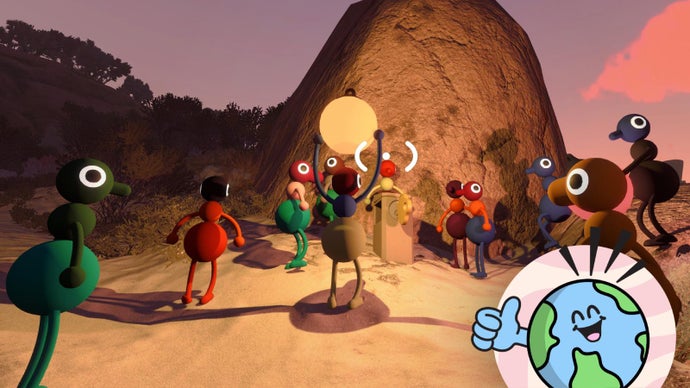
Loneliness inspired an experiment to gauge the impact of gathering people together online, even those who don't typically play games. The catalyst for this experiment was Big Walk, a game that encourages people to hang out, solve puzzles, and have fun together. I opted to bring individuals together in a virtual space, as I too experienced the profound sensation of gathering people into a single location.
As a member of Eurogamer's Optimism Week, I became a matchmaker, hoping to create an environment where people could connect, laugh, and create memorable moments. Big Walk's simplicity is what makes it so captivating; one's presence alone brings about a sense of joy and wonder, as evidenced by the myriad of actions one can perform within the game, such as shaking a bell, sliding down a slide, or picking up others.
What's intriguing about Big Walk is its deliberate reduction, making it accessible to anyone, regardless of their gaming experience. There are no player names, and participants are identified solely by their paint jobs. This anonymity fosters a sense of safety, as players are free to express themselves without the pressure of being judged or recognized.
As the group of 12 individuals ventured out of the tutorial, they scurried across the grass, separated into different activities, and formed smaller groups as needed. However, the game's puzzles were designed to accommodate up to four players, so the larger group often struggled to coordinate on complex tasks. Yet, as individuals gravitated towards smaller subgroups, they began to form their own unique experiences, breaking away from the main group and embarking on their own adventures.
The game's eerie atmosphere, with its infant-like visuals and limited communication options, adds to the overall sense of excitement and discovery. Big Walk's ability to evoke such strong emotions, even in the absence of a fully fleshed-out narrative, is a testament to the power of human connection and the profound impact it can have on our well-being.
Written by urgent.news from Eurogamer's reporting — not their text. Machine-written — may contain errors; check the original before relying on it.