Drehscheibe mit Reichweite: Bilger bei BASF - Chemiekonzern setzt auf Verkehrsmix
Wenn der Rhein bei Niedrigwasser zum Nadelöhr wird, gewinnen Straße und Schiene an Gewicht. Ein Millionenprojekt soll die Infrastruktur ausbauen.
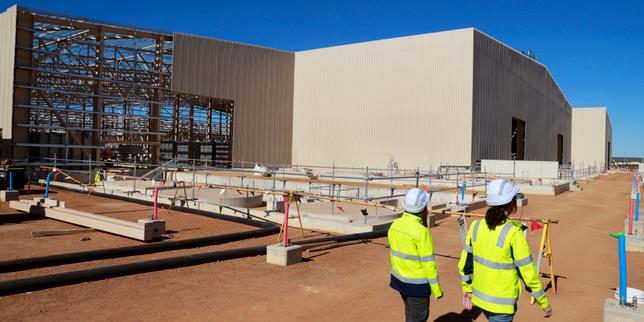
The German chemical conglomerate BASF is planning to enhance its transportation capabilities by connecting roads and railways more effectively. Federal Transport Minister Steffen Bilger (CDU) and Group CEO Markus Kamieth marked the launch of the expansion of the Combined Transport Terminal (KVT) in the north of the main plant in Ludwigshafen today at 1:00 PM.
The modernization project has been allocated 51 million euros in funding. The integrated transport is of particular importance for the world's largest chemical company, with around 40% of its production in Ludwigshafen transported via the Rhine. In the event of restrictions on river shipping, such as during low water levels, the combination of road and rail can help secure the supply of essential raw materials.
The KVT is considered one of the most important and largest European handling terminals for combined transport by rail. Daily, over 1,100 cargo units up to 25 full trains are loaded. The facility is connected to key economic areas and European transport corridors, particularly to Italy, Spain, Eastern Europe, and Scandinavia. Since its launch in 2000, over 7.5 million shipments have been processed, avoiding an equivalent number of truck transports over long distances.
Approximately 30 to 40% of the handled volumes consist of BASF products. The remaining capacities are available to external freight forwarders and shippers. The KVT also plays a crucial role for the region as a logistics location. The expansion aims to upgrade the terminal for future freight transport requirements. The four existing cranes will be replaced by three new ones with a span of more than 100 meters, while the possibility of extending to four cranes remains.
The loading and unloading areas for trucks will also be optimized. By allowing the transfer of goods between trucks and trains, the terminal helps shift longer distances from road to rail. Located at the northern edge of the BASF plant, the terminal is expected to buffer the freight traffic from Ludwigshafen and reduce the burden on the second-largest city in Rhineland-Palatinate.
The KVT has a surface area of approximately 260,000 square meters and accommodates 13 handling tracks, enabling the handling of up to 370,000 cargo units annually. BASF owns the terminal, which is operated by Kombi-Terminal Ludwigshafen GmbH (KTL). Besides BASF, the terminal is shared by Bertschi from Switzerland, Hoyer from Hamburg, and the combined transport specialists Hupac and Kombiverkehr.
Today, the Rheinland-Pfalz State Secretary for Transport Markus Wolf and Ludwigshafen's Lord Mayor Klaus Blettner (CDU) are expected to be present.
Written by urgent.news from Handelsblatt's reporting — not their text. Machine-written — may contain errors; check the original before relying on it.