AI Coding Tip 032 - Build a Dark Factory Pipeline
Run your pipeline like a dark factory: automated, sampled, and policed by an adversarial model.
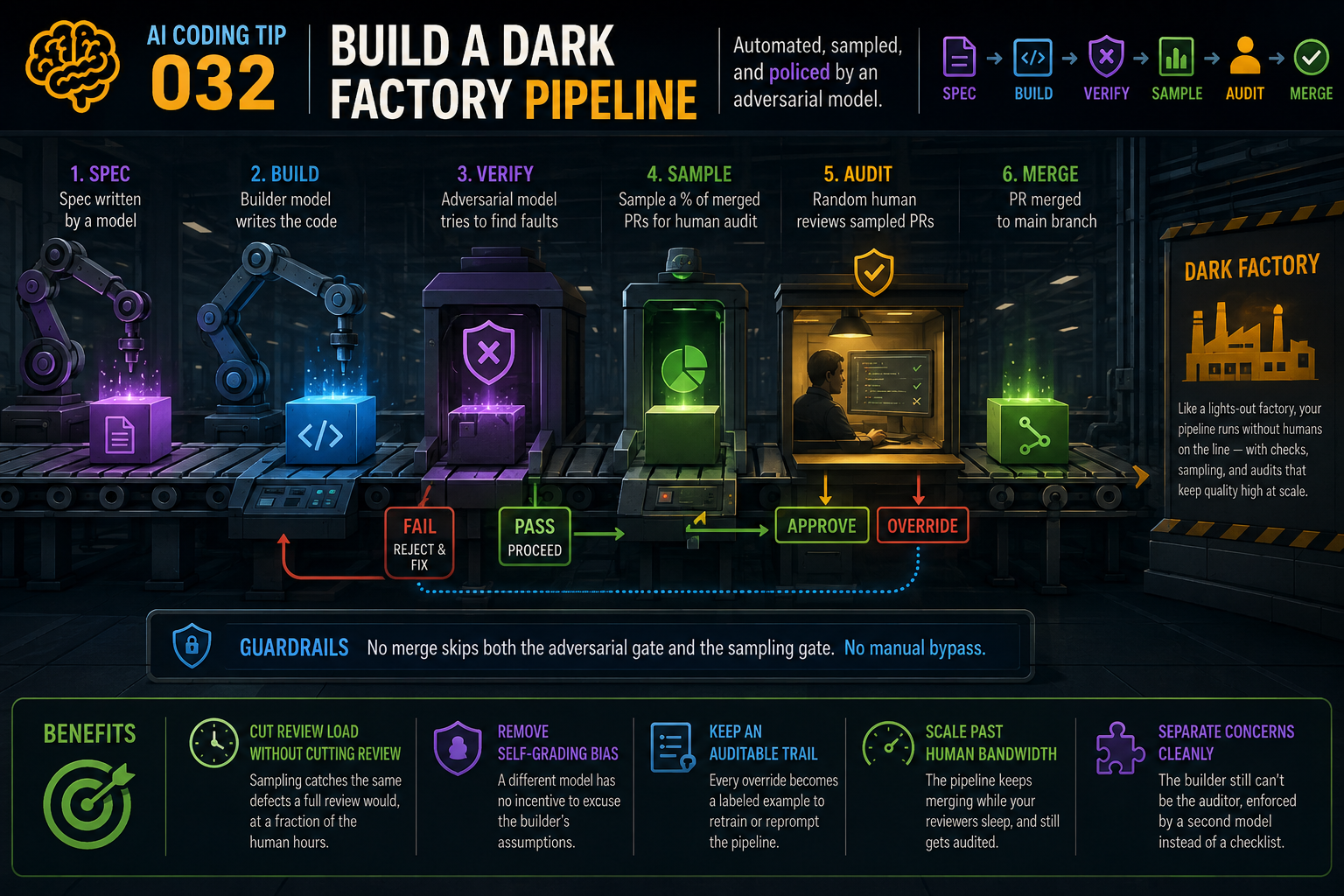
Create a manufacturing system for code where no human is needed, maintain a steady flow of code, and incorporate regular human inspections. In essence, manage your pipeline as if it were a dark factory: automated, sampled, and monitored by an adversarial model. Common Error ❌ You allow one model to compose a pull request, then rely on the same model (or a subtly similar new version) to certify its own work.
Humans, like you, are a precious resource and a bottleneck, so you conclude that others will not examine the differences. Issues Resolved 😔 Models favor their own output when asked to assess it, a proven self-preference bias that renders peer review as objective as a biased jury verdict. Avoid full checks, and your pipeline will become a backlog of unfixed code that no one notices until it is released.
100% human review is not feasible when dozens of pull requests are merged daily. Simulated full coverage appears safe on a dashboard much like vanity coverage, impressive on a presentation deck, but useless in real-world execution. Skip the secondary opinion, and your pipeline will gradually repeat its own errors. How to Execute 🛠️ Employ a proficient builder model to craft the code based on a specification written by another model.
Engage a separate model, potentially from a different vendor or series, as the adversarial verifier, whose sole responsibility is to identify flaws in the builder's output. Reject any pull request flagged by the verifier, and require the builder to rectify it before a human in the loop can assess it. Determine a sampling frequency for human audit, akin to quality control sampling a manufacturing batch rather than inspecting every item (you cannot scale the inspection to 100%).
Direct that sampled percentage of merged pull requests to a random human reviewer, not the simplest or newest ones. Record each instance where a human contradicts the adversarial verdict, and utilize these cases as correction signals for subsequent runs. Block any merge that bypasses both the adversarial gate and the sampling gate, without manual intervention.
Advantages 🎯 Decrease review workload without compromising review standards: Sampling detects the same type of errors a complete review would, but with a fraction of the human effort. Eliminate self-grading bias: By policy, a distinct model has no motivation to justify the builder's assumptions. Maintain an auditable record: Each human override becomes a labeled example that can be used to retrain or refine the pipeline.
Scale beyond human capacity: The pipeline continues merging while your reviewers rest, yet remains audited when they are awake. Clearly Separate Responsibilities: The builder cannot also be the auditor, supervised by a second model rather than a checklist alone. Context 🧠 Factory automation, pioneered by the Taylorist method, illustrated this principle decades before software did.
Despite the widespread belief that a lights-out factory operates without any human presence, the reality is that human intervention is still necessary on the production floor. Foxconn replaced 60,000 employees at its Kunshan plant with robots that assemble phones around the clock, and the term "dark factory" originated from this setup because the machinery does not require lighting.
A related approach in some data centers involves hypoxic fire suppression, maintaining oxygen levels around 14-15 percent, similar to a mountain peak, which is insufficient to support combustion but safe for human technicians to operate within. This represents a guardrail that prevents fires without the need for a human constantly monitoring the environment.
The software industry has adopted the dark factory analogy, envisioning a specification entering the system, production code exiting, and no human involvement in between. The Auditor Cannot Be the Builder Manufacturing history has taught us that oversight is best achieved through acceptance sampling: taking a random, small portion from each batch and allowing that portion to decide whether the entire batch meets standards.
You can apply the same statistical principles to code: rather than reviewing every merged pull request, randomly sample a defined percentage and trust that sample to reflect the entire set. The critical oversight in many autonomous coding pipelines is the omission of the adversarial gate, leading to a costly rubber stamp system.
Academic research on adversarial code review corroborates the conventional wisdom that developers should not evaluate their own work, as the same biases that produce the defect also create blind spots in the review process. Studies on self-preference bias support this assertion with empirical data: models trained on the same family score their own outputs higher than an impartial judge would.
This occurs because the builder and its verifier need to originate from different vendors to mitigate this issue. Reference Prompt 📝 Bad Prompt 🚫 Write the pull request for the new caching layer, then review your own diff and determine if it is ready to merge. If it appears fine to you, merge it directly. I do not require review unless you have doubts about your work.
Good Prompt 👉 Model A (builder): create the pull request for the new caching layer from the provided specification. Do not approve your own diff. Model B (verifier, from a different vendor than Model A): review the diff, focusing solely on defects. Reject the pull request if any issues are found, and provide a detailed explanation of the problem.
Do not rectify the issue yourself. Route 10% of every batch of merged pull requests, chosen randomly, to a human reviewer. Document every case where the human reviewer overrules Model B's verdict, regardless of whether it agrees or disagrees. Track the number of defects identified by human reviewers.
Written by urgent.news from HackerNoon's reporting — not their text. Machine-written — may contain errors; check the original before relying on it.