A 'river' of cosmic gas 1 trillion miles long sent planets in the Orion constellation into tilted orbits
A river of gas over a trillion miles long is streaming onto a young planet-forming system and is tipping it over.
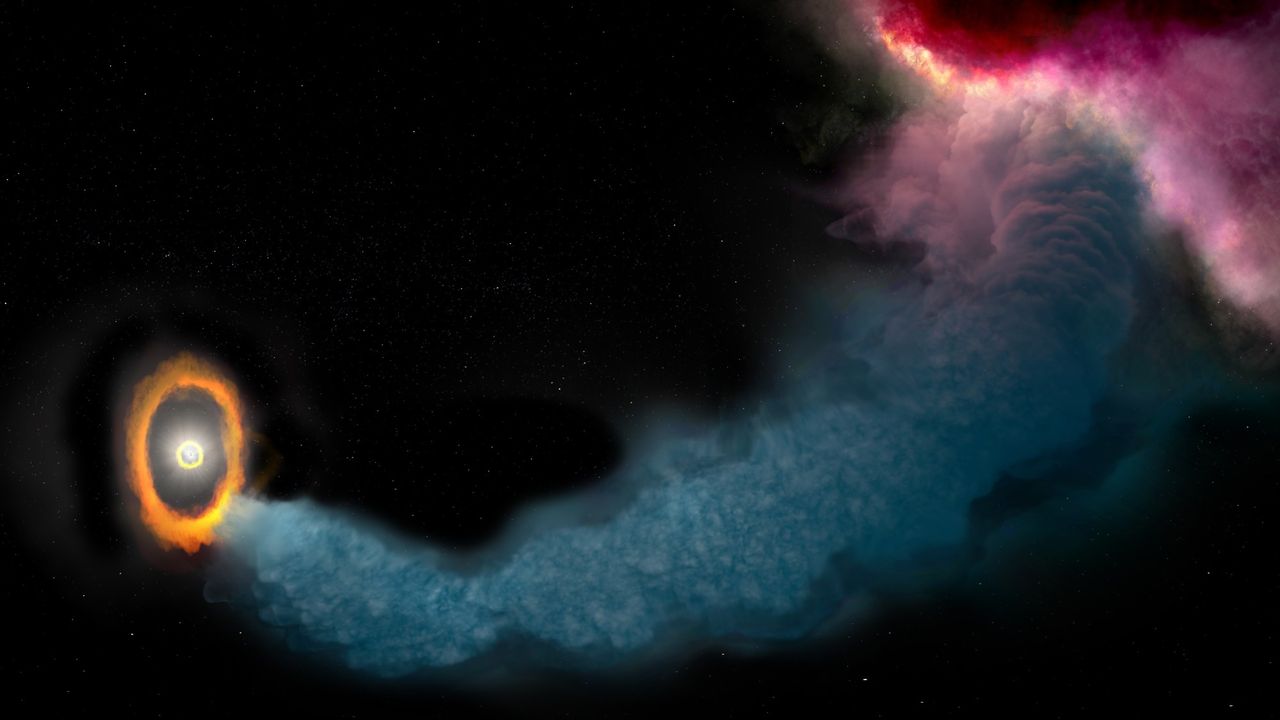
A massive river of gas, spanning over a trillion miles, has caused astronomers to discover a peculiar situation in the Orion constellation. The streamer, composed mostly of molecular hydrogen, is responsible for tilting the outermost ring of a planet-forming disk around a young triple-star system known as GW Orionis. This disk, which orbits three pre-main sequence stars, is unusual as it consists of three rings with misaligned orbits.
GW Orionis, located approximately 1,300 light-years away, poses a mystery as to why astronomers have found planets with orbits that are drastically misaligned with their stars' rotational axes. The streamer's impact on the outer ring is such a strong influence that it has warped the ring and tipped it over, altering its angle. The team's models suggest that the streamer, which is approximately 12,600 astronomical units in length, has significantly contributed to the disk's misalignment.
This discovery may help explain the cause of exoplanets with highly inclined or even retrograde orbits. If streamers are common in such young star systems, it could mean that planets do not always end up in orderly orbits, but rather take on more random orientations. The researchers plan to conduct a systematic survey of young stars to determine the prevalence of streamers and their impact on planetary systems.
Written by urgent.news from Space.com's reporting — not their text. Machine-written — may contain errors; check the original before relying on it.