Urgent.News

One page, thousands of outlets. See who else covered it.

Editions

Finance & Markets

Transportprobleme: Niedrigwasser: Ökonomin Grimm sagt steigende Preise voraus

Die Preise könnten bei diversen Grundstoffen steigen, warnt die Wirtschaftsweise. Sie kritisiert die Politiker, die kurzsichtig agierten, statt sich auf solche Lagen vorzubereiten.

Transportprobleme: Niedrigwasser: Ökonomin Grimm sagt steigende Preise voraus

German economist Veronika Grimm has warned of rising prices due to low water levels on German rivers and the resulting transport issues. "Inefficient rationing can unnecessarily drive prices up with low water," Grimm told the "Kölner Stadt-Anzeiger". The chemical industry and energy market are also affected by the low water levels.

The extent to which prices react to different raw materials depends on the storage capacity that companies have built up. Grimm criticized a lack of foresight in politics regarding adaptation to climate change. He argued that a ban on Sunday driving for trucks is a good measure, but it would be better to prepare for such situations rather than discussing ad hoc emergency measures.

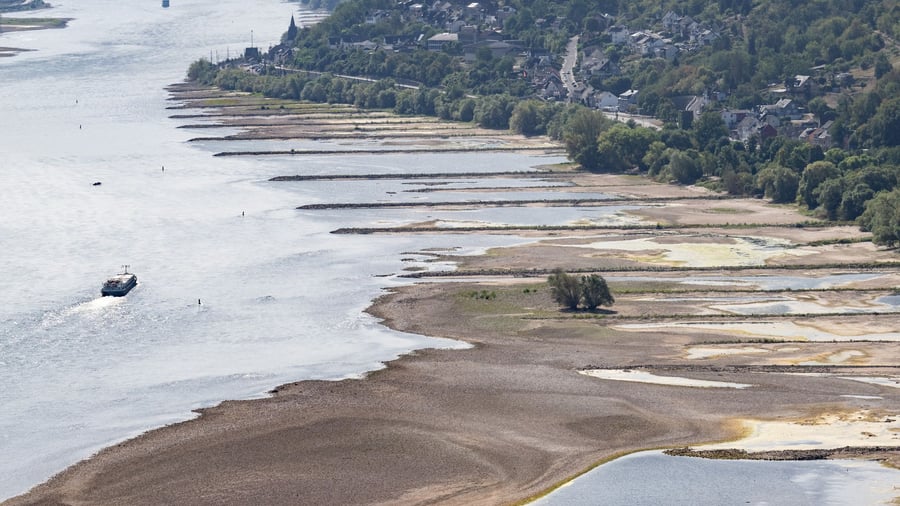
The effects of climate change can be predicted, and it is not as simple as deepening rivers to solve transport problems. Deepening at individual points in the canals might be appropriate, but it does not create additional water. The government should also develop plans to prioritize transportation. Currently, the level of the Rhine in Düsseldorf has reached a historic low.

It has dropped to a negative level for the first time in the recorded data. The water level in Düsseldorf is significantly lower than the level at the riverbank. Over the next week, a slight increase in the water level to 10 centimeters is expected, but the Rhine will continue to remain at a very low level. The waterway authority stated that few ships are sailing due to the low water levels.

The German Chamber of Commerce and Industry (DIHK) said that the chemical industry is mainly affected by the low water levels on the Rhine. While most of the bulk goods shipped on the Rhine are low-priced items like coal, sand, or mining products, many large chemical plants are located along the river, where petrochemical intermediates are further processed.

Without measures to increase the resilience of waterways, the barge industry may no longer benefit from the advantages of inland shipping in the future. DB Cargo plans to reactivate old freight wagons to compensate for canceled ship transports. They could immediately mobilize 900 wagons, with 300 available immediately. DB Cargo CEO Bernhard Osburg said that 900 wagons could replace 200 barges.

The rail passenger association Pro Bahn welcomed this development but feared it might lead to restrictions in passenger transport. Lukas Iffländer, the president of Pro Bahn, said, "More goods on the rails: yes. Fewer trains for passengers: no." He criticized both sides for not having invested enough in logistics strategies. Rheinland-Pfalz/Saarland Verband chairman Noah Wand also criticized political priorities, stating that economic supply chains are often put under pressure, and quick political responses are made, while passengers often remain unheard.

Federal Transportation Minister Steffen Bilger (CDU) is advocating for shifting bargeloads to rail and road transport.

Written by urgent.news from Handelsblatt's reporting — not their text. Machine-written — may contain errors; check the original before relying on it.

Also reported by 1 other outlet

Read the original at handelsblatt.com →

More in Finance & Markets

More from Sunday 16 August →