NASA funds spherical 'Aerobots' that could explore the caves of Saturn's moon Titan
An early-stage grant is offering a look at spherical 'Aerobots' that could zoom around the caves of Titan, in a demo mission similar to Mars Ingenuity.
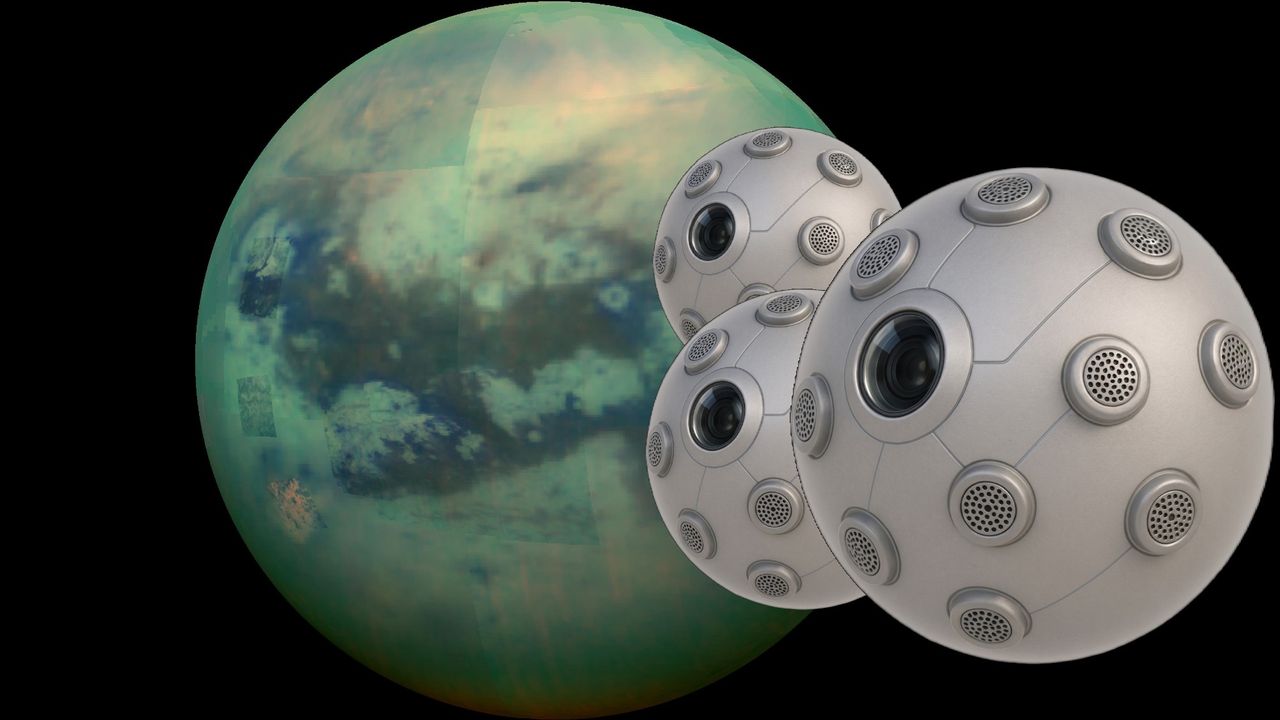
NASA has awarded funding for a new project called SPARK (Solid-state Propulsion for Autonomous Reconnaissance of Karst) which aims to develop spherical Aerobots capable of exploring the caves on Saturn's moon Titan. Titan is known for its hydrocarbon rivers, lakes, seas, and unique karst terrain including underground sinkholes and caves that rovers struggle to navigate.
The aerobots, dubbed SPARK, are small flying vehicles that could potentially overcome these challenges. However, it remains uncertain if SPARK will be ready for NASA's Dragonfly mission to Titan, which is scheduled for a 2028 launch. SPARK is currently in its Phase 1 grant, with a possibility of extending through Phase 2 if needed.
If the mission is delayed, SPARK could still find a place in the exploration of Titan's caves. Daniel Drew, the project lead from the University of Hawaii, envisions SPARK providing persistence, maneuverability, and robustness in the challenging conditions near Titan's icy surface. He hopes SPARK could become a pioneer for cave exploration on Titan, similar to the Ingenuity helicopter on Mars.
Drew's SPARK project draws inspiration from hobbyist designs of ion-propelled flying robots and has already achieved milestones such as the first microfabricated EHD actuators and a centimeter-scale ionocraft taking off and carrying a payload. While EHD propulsion may not be the most efficient compared to conventional techniques, Drew emphasizes its simplicity, scalability, and quiet operation, making it a unique option for specific applications, including Titan's caves.
Written by urgent.news from Space.com's reporting — not their text. Machine-written — may contain errors; check the original before relying on it.