China’s ‘electric eel’ sensor allows robots to feel an object without touching it
Electric eels hunt in pitch-black, murky waters by generating electric fields around their bodies. Now, Chinese scientists have mimicked this natural radar, giving robots the ability to “feel” objects without making physical contact. “We want the machine to sense an approaching target – distinguish its material and surface condition – before any physical contact,” said Zhang Weiqiang, a professor…
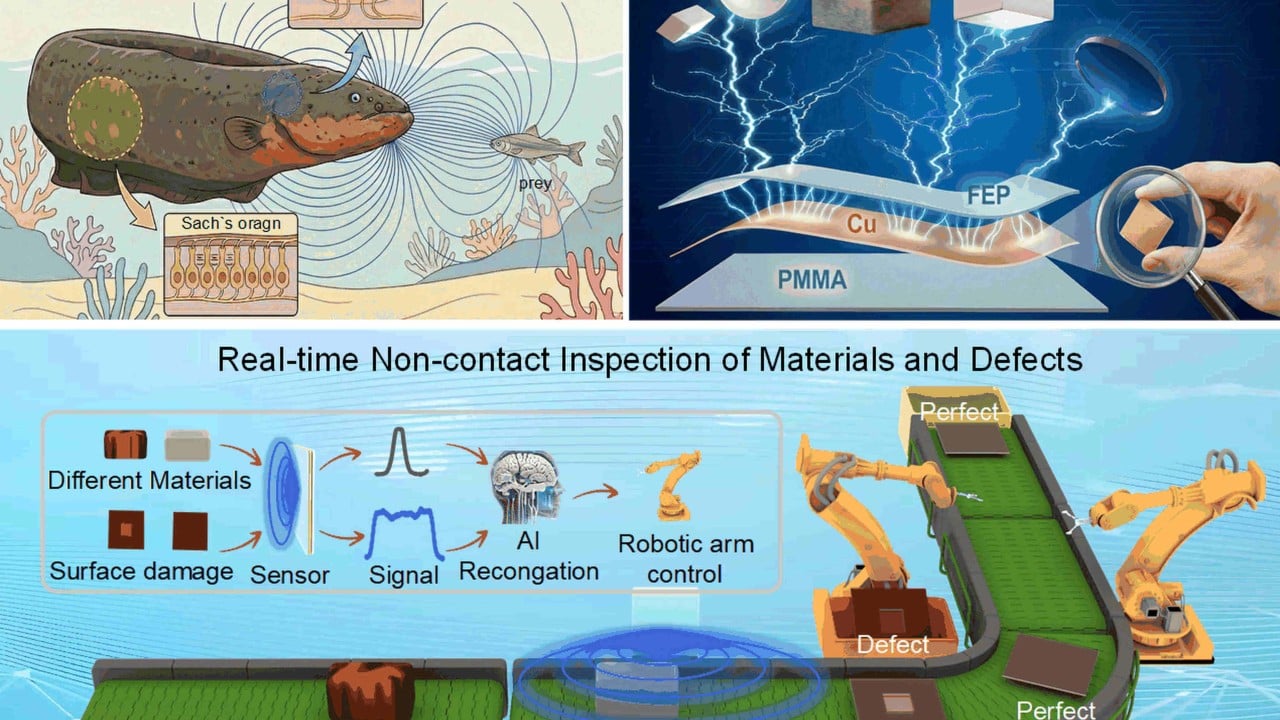
Chinese scientists have created an "electric eel" inspired sensor that allows robots to sense objects without physically touching them. The sensor, published in the peer-reviewed journal Advanced Materials, mimics the natural radar system of electric eels which generate electric fields around their bodies to locate prey.
The researchers, led by Zhang Weiqiang from Xidian University, created a sensor made of a specially treated fluoropolymer which acts like a tiny static battery. Once charged, it maintains its charge for an extended period, creating a steady electric field around it. When an object gets close, the sensor detects changes in the field, from which it can infer various properties of the object like electrical conductivity, dielectric properties, and geometric shape.
The sensor's sensitivity is impressive, able to detect movements as small as 50 micrometres - half the width of a human hair, producing a voltage change of about one volt. It has shown remarkable stability over 10,000 cycles of approach and retreat without any noticeable signal degradation.
One major advantage of this sensor is its versatility. Unlike conventional sensors, it doesn't rely on lighting conditions and can detect various materials including metals, plastics, glass, and wood. This makes it a potential game-changer for applications such as robot manufacturing, equipment inspection, and human-robot interaction.
The sensor could complement other detection systems like vision, infrared, and inductive systems for non-contact detection. For instance, it could be used in coating inspection or as a proximity warning system on an assembly line. It could identify materials from a distance, distinguishing items that look identical in color and appearance based on their different materials.
In industrial non-destructive testing, it could effectively detect dents on coated glass, stainless steel, and other surfaces. In aerospace applications, it could be beneficial for space robot operations, monitoring equipment outside spacecraft, and on-orbit maintenance by robotic arms.
Currently, the sensor requires close proximity to react. However, the next steps involve extending its range and improving its accuracy in complex environments.
Written by urgent.news from Reuters Business via SCMP's reporting — not their text. Machine-written — may contain errors; check the original before relying on it.