Tod eines Kernkraftwerks – der Rückbau des AKW Mühleberg ist die komplexeste Baustelle der Schweiz
Stefan Klute ist der Totengräber des Kernkraftwerks Mühleberg. Der deutsche Kerntechniker in Diensten der BKW ist zuständig für den ersten Rückbau eines Schweizer AKW. Es ist fast eine Lebensaufgabe.
Stefan Klute is the undertaker of the Mühleberg nuclear power plant. As a German nuclear engineer working for BKW, he oversees the dismantling of the first Swiss nuclear power plant. This task is nearly his life's work. Looking up into the reactor is like gazing into the heart of an atomic power plant. The heart of the Mühleberg nuclear power plant has not beat for nearly seven years since its power output was shut down on December 20, 2019.
The plant is the most complex construction site in Switzerland. The NZZ.ch website requires JavaScript for key functions, which is currently blocked by your browser or ad blocker. Inside the nuclear power plant, nothing needs to be cooled anymore as the reactor pressure vessel is depressurized and opened. The view into the inner workings of the reactor core is now possible due to the absence of pressure.
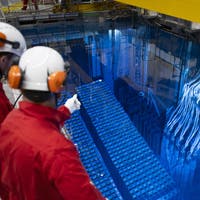
Standing at +29 meters in the Mühleberg nuclear power plant, you can look down at the illuminated water at the bottom of the round reactor pressure vessel. It looks like a lifeless eye without a pupil looking back. Highly radioactive fuel elements have already been removed. The remaining components in the reactor, which once sat under the fuel elements, must still be cut and packaged into smaller pieces due to the high radiation.
All of this is done underwater and remotely from the control room above the reactor. On several screens, employees in their red overalls can closely observe and control the underwater processes. "Every meter of water reduces radiation by a factor of 1000," says Stefan Klute. As the reactor pressure vessel was pressurized with about 70 bar of steam heat from the fuel elements, it generated steam that drove the turbines and ultimately the generator, producing electricity.
The pressure vessel was enclosed in a containment vessel. Both covers have now been removed. The containment vessel cover is being cut. The reactor pressure vessel cover is scheduled to be cut from September. Now, there are still 8 or up to 15 meters of water above the components still inside the reactor. Therefore, one can safely look into the former heart of the reactor during a visit.
However, it is still in a high-security zone. To get there, one must change shoes, inserts, and protective suits several times. "Removing the fuel rods has eliminated over 99 percent of the radioactivity from the nuclear power plant," says Klute. The German moved to Switzerland in 2014 to start the dismantling. He had worked for the German company Siempelkamp for over a decade in the nuclear industry before coming to Mühleberg.
The Mühleberg nuclear power plant was a 373-megawatt pressurized water reactor with river water cooling. The water came directly from the Aare River. The critical element of the dismantling was removing the fuel elements from the reactor and transporting them to the interim storage facility. This phase was completed at the end of September 2023.
Trucks delivered the remaining 418 fuel elements in special containers, in 65 transports, to the interim storage facility in Würenlingen, about 120 kilometers away. The fuel elements are now stored in eight transport and storage containers, known as Castor containers. No splicable or heat-generating radioactive waste remains in Mühleberg since early 2023.
The fuel elements have been moved quietly. This is not without challenges. In Germany, transporting the Castor containers used to often result in protests from anti-nuclear activists, sometimes escalating into street clashes with police. In Switzerland, however, no hundreds of people were needed to secure the transport. In the interim storage facility in Würenlingen, there are various buildings for low-, medium-, and high-level radioactive waste.
The hall for high-level radioactive waste stores the Castor containers. These remain there until the fuel elements are moved to specialized deep geological repositories. Eventually, they could be moved to a geological deep repository being built a few kilometers east of Baden. But what if a large aircraft crashes into the interim storage facility?
Klute smiles. The question of safety is a constant concern. "The containers would survive," he says. Different countries have different perceptions of risk. "In the US and Spain, similar containers are sometimes stored outdoors," explains Klute. "In Switzerland and other countries, we build a hall around the containers, and in Germany, both the hall and the containers are designed to withstand aircraft crashes," adds Klute.
These country-specific differences are also seen in other phases of the dismantling. "In Switzerland, the authorities approved the dismantling process after two and a half years, whereas in Germany, approvals for the first nuclear power plant dismantlings took over five years, and in Spain, they took five to eight years," says Klute.
Some countries also require full 3-D simulations for non-safety-related tasks as part of the dismantling. Klute finds this excessive. "We focus our use of 3-D in planning on work with significant safety relevance. Ultimately, the dismantling takes place on site and not on the PC." The dismantling is also under regular supervision: employees of Ensi, the Swiss nuclear waste management company, oversee the process.
Written by urgent.news from NZZ Wirtschaft's reporting — not their text. Machine-written — may contain errors; check the original before relying on it.