Nihang Sikhs | The warrior tradition
The recent attack on the Akali Dal chief in Maharashtra has brought the community, traditionally regarded as ‘Guru’s army’, back to public attention
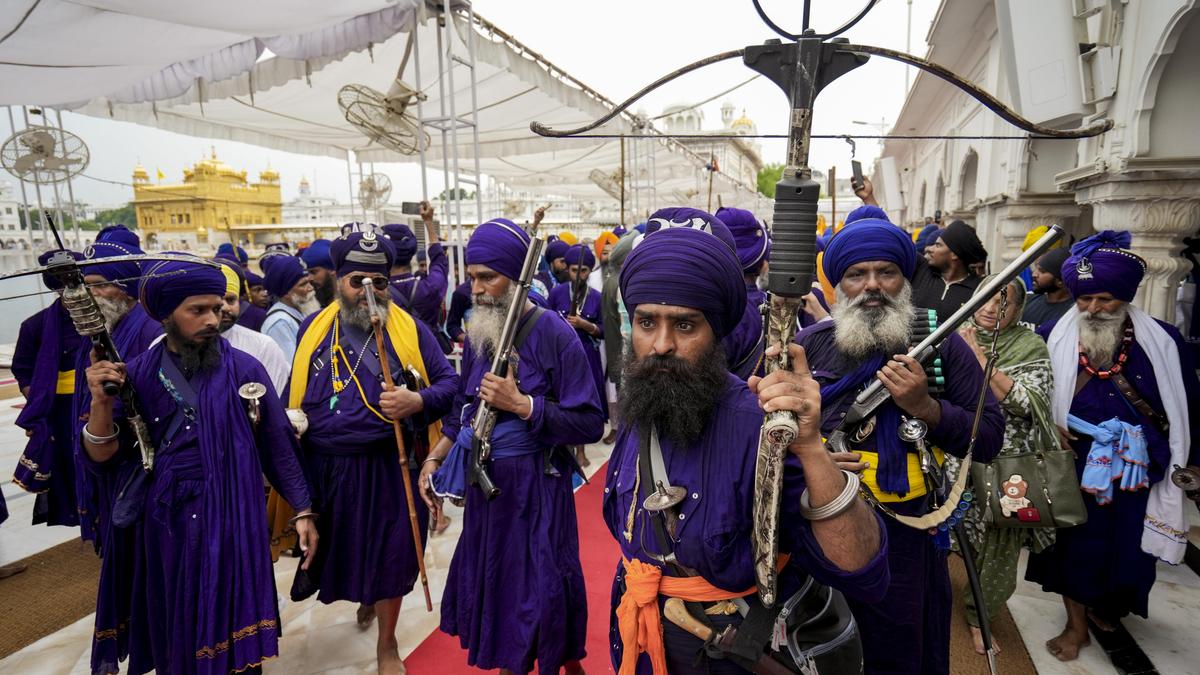
Nihang Sikhs are easily recognizable with their blue robes, tall conical turbans, and weapons such as swords and spears hanging from their bodies. They maintain a warrior tradition within Sikhism, which originated from the creation of the Khalsa Panth by the 10th Sikh Guru, Gobind Singh, in 1699. The Nihangs are associated with fearlessness and detachment from worldly attachments, with the term 'Nihang' derived from the Persian word 'nahang,' meaning crocodile, symbolizing their ferocity and toughness.
Historically, Nihang warriors were mobile fighting groups defending Sikh settlements and religious institutions against military persecution from Mughal forces and later Afghan invaders. Their martial tradition later integrated into the Sikh misls and Maharaja Ranjit Singh's forces. However, their battlefield role diminished with the end of that era of warfare.
Today, Nihangs primarily serve as custodians and practitioners of their religious and martial tradition, rather than a standing army. They are not governed by a single organization, but instead comprise several factions with no central command or membership registry.
The Nihang community's mobile and decentralized nature means that they travel with their horses and jathas, following an annual religious circuit that includes major Sikh centers and festivals. This tradition keeps them connected to places of historical significance, allowing them to gather, worship, train, and showcase their skills. The most notable such event is the Hola Mohalla held at Anandpur Sahib, where Nihangs engage in mounted Gatka displays and mock battles with traditional weapons.
The weapons carried by Nihangs are not just accessories but signify readiness and their historical responsibility to protect the vulnerable and defend dharam. Another key principle for Nihangs is chardi kala, a state of resilient optimism. However, scholars caution against equating the uniform with the institution, as mere appearance may not indicate adherence to the traditional order, which demands adherence to bani (wisdom), bana (attire), spiritual practice, and outward discipline.
Joining the Nihang community involves a commitment to a specific group, its jathedar, and its code. Members are expected to adhere to not only the practices but also the terminology, discipline, and interpretation of the tradition. The lifestyle of a Nihang is not necessarily renunciation of family or livelihood, as some members maintain a disciplined religious life within their dals while also marrying, working, and raising families while fulfilling their obligations to their jatha.
Their tradition of movement and collective identity has also brought Nihangs into contemporary public life, though individual actions or appearances should not be attributed to the entire community.
Written by urgent.news from The Hindu's reporting — not their text. Machine-written — may contain errors; check the original before relying on it.