Minnesota teen builds low-cost system that cut seizure recurrence 70% in model
Evan Morris created a low-cost system using worms and ultrasound. This system helps study seizure suppression and reduces recurrence by seventy percent. The project utilizes sonogenetics and a computer-controlled closed-loop detection method. Morris received a significant award for his innovative life science research. His work offers a faster, less expensive platform for neuroscience exploration.
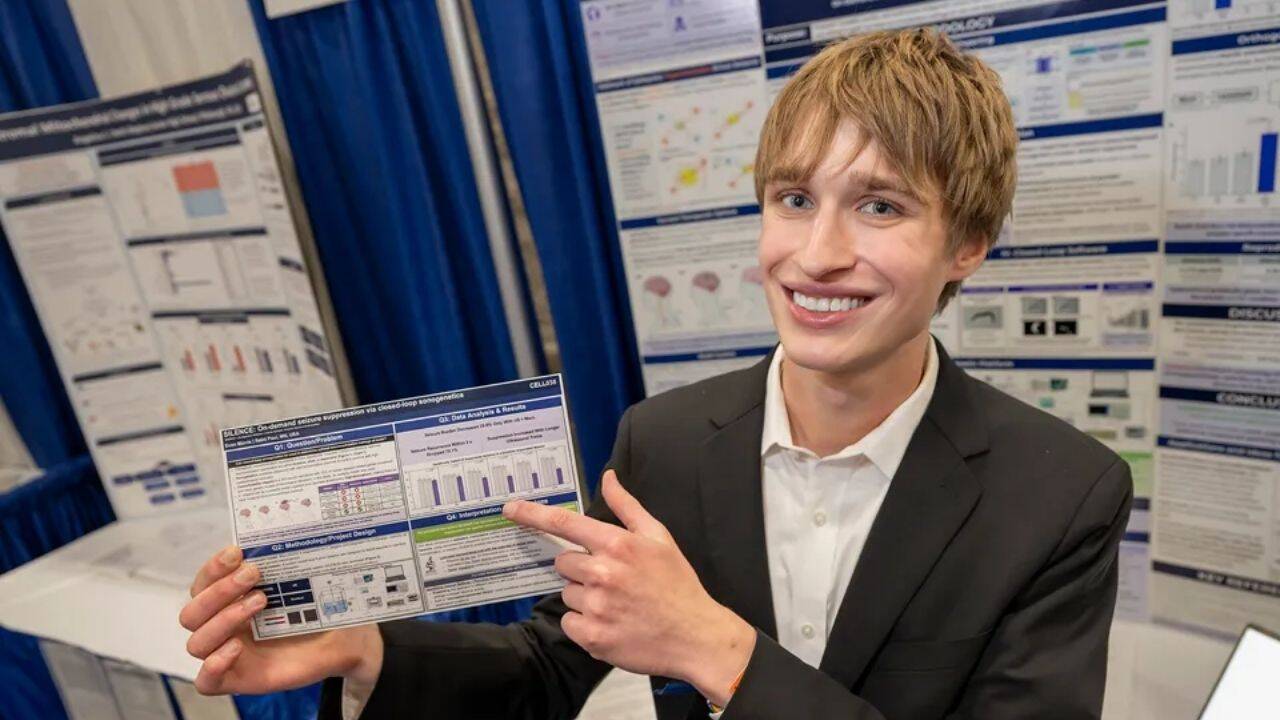
Evan Morris, an 18-year-old high school student from Saint Paul, Minnesota, has created a low-cost experimental system that could help researchers study how brain stimulation may control seizures. The project, named SILENCE: On-demand seizure suppression via closed-loop sonogenetics, utilizes genetically modified worms, a computer-controlled detection system, and ultrasound to identify and interrupt seizure-like activity.
Morris won the $10,000 Mary Sue Coleman Award for Life Science Innovation & Impact for his project at the 2026 Regeneron International Science and Engineering Fair.
Morris's system, which uses sonogenetics, a technique that employs ultrasound to influence genetically modified cells, works by inserting an ultrasound-sensitive channel into the brain cells of Caenorhabditis elegans, a tiny worm frequently used in biological research. The system then detects seizure-like activity in the worms and, when it occurs, automatically triggers an ultrasound stimulus to interrupt the abnormal activity.
This creates a closed-loop system, allowing researchers to continuously monitor activity and respond when needed.
The results of Morris's experiments were impressive. By testing different stimulation settings, the system achieved a 70.1% reduction in seizure recurrence and a 30% decrease in overall seizure activity. While this does not mean that the worm system can directly treat epilepsy, it provides a promising platform for researchers to study how stimulation affects neural activity and identify promising stimulation settings before moving onto more complex studies.
The low-cost design of Morris's project could also make repeated experiments more accessible, as rapid testing of various stimulation parameters in a living model could help identify promising approaches more efficiently.
Written by urgent.news from Times of India's reporting — not their text. Machine-written — may contain errors; check the original before relying on it.