Building an AI Text Detector From Scratch
An End-to-End Project With Dataset Construction, Model Training, Local Deployment, and RLVR
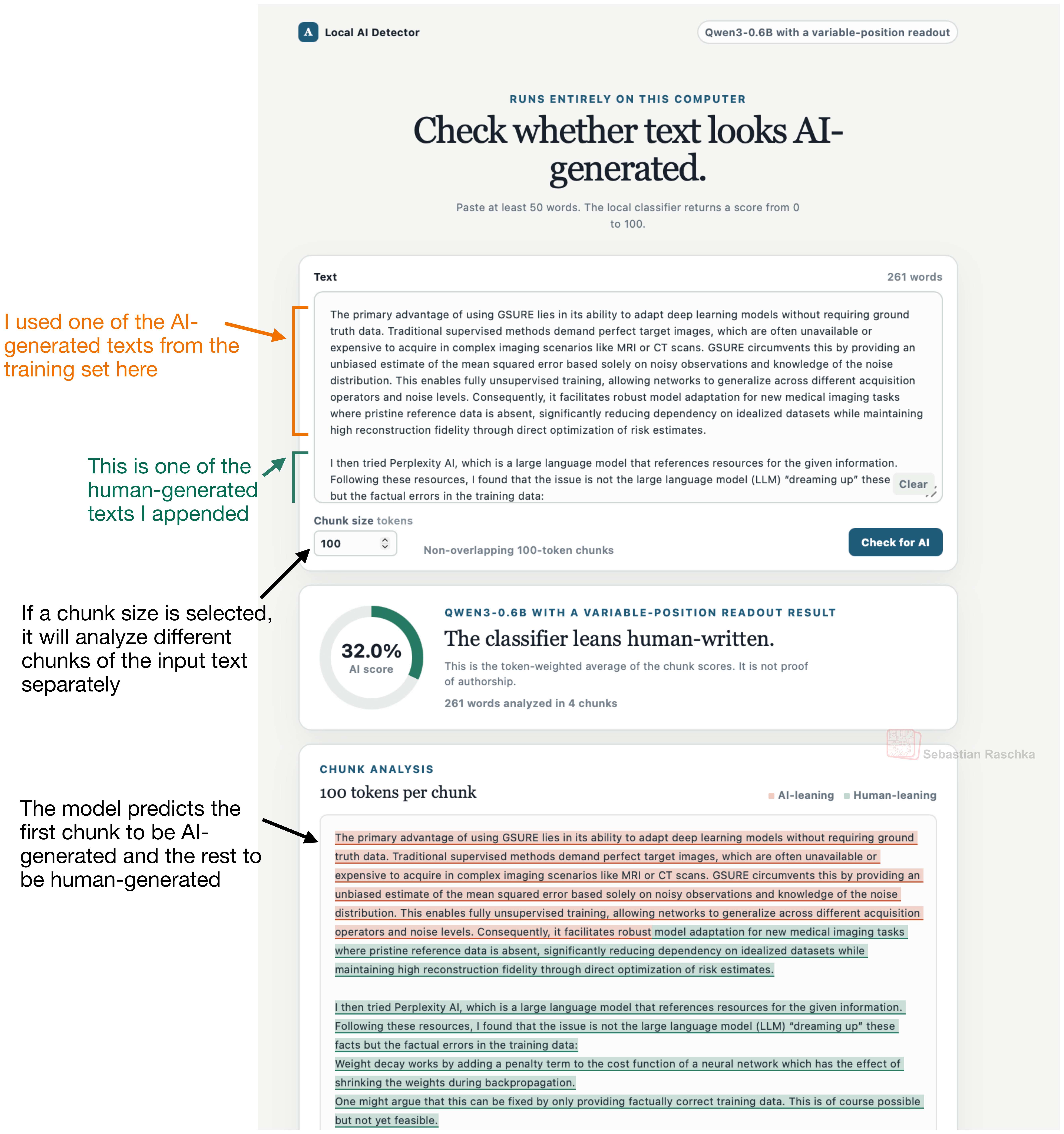
Recently, Substack introduced an AI detector feature within its user interface, which is quite intriguing. Concurrently, numerous individuals inquired about fascinating DIY LLM projects for demonstration purposes, illustrating the capabilities of small language models (SLMs). Combining these two aspects, I decided to create a tutorial that demonstrates the construction of an AI detector, which can also serve as a verifier for a small language model.
The objective is to analyze the constraints of AI detectors and investigate an application for a verifier-based LLM, beyond conventional reasoning models trained on mathematics and coding. Figure 1 showcases Substack's built-in AI detector. The primary objective of this tutorial is to elucidate how AI detectors function through the creation (of a basic one).
In reality, such a detector could be employed to filter out spam content, but it could also be utilized to enhance your personal writing by avoiding the appearance of AI-generated text. For instance, if you authored an extensive article and wished to refine its spelling and grammar, it might be appealing (and beneficial) to employ a grammar checker to refine it and enhance its readability.
There are various services available for this purpose, including general-purpose LLMs like ChatGPT. However, this also entails the possibility of inadvertently or intentionally overpolishing your writing, resulting in it sounding like AI-generated content and consequently being flagged as spammy. Utilizing an AI checker, one might instruct, "Refine my grammar while ensuring that my text retains a 0% AI-generated signature."
While our current endeavor involves the development of a fully operational checker, the primary aim is to elucidate (1) the functionality of AI checkers and (2) to utilize this as a case study for a broader topic on constructing scorers or verifiers compatible with LLMs. It is important to note that AI checkers operate in a dynamic "cat-and-mouse" scenario.
As AI checkers identify patterns suggestive of AI-generated content, subsequent LLMs may either inadvertently or deliberately alter to avoid detection. Consequently, AI checkers must be updated to recognize these changes, and the cycle continues. Additionally, AI checkers are susceptible to false positives, where human-generated text is erroneously classified as AI-generated; a topic that will be explored later.
The project's goals are multifaceted. The central objective is to demonstrate the functionality of AI detectors and present an end-to-end LLM project, encompassing evaluation, training, and local deployment for practical application. The culmination of this project is an AI-detector API that can be utilized by both humans and agents, as well as a user-friendly interface.
Written by urgent.news from Sebastian Raschka's reporting — not their text. Machine-written — may contain errors; check the original before relying on it.