Beyond The 'Midnight Hour': The 79-Year Saga Of How India Forged A Legacy Of Strength & Statecraft
New Delhi: "At the stroke of the midnight hour, when the world sleeps, India will awake to life and freedom," declared India's first Prime Minister, Jawaharlal Nehru, near midnight on August 14, 1947. The next morning, India woke up as a free nation after nearly two centuries of struggle against colonial rule. 79 years ago, at independence, Indian defence was defined by the complex transition…
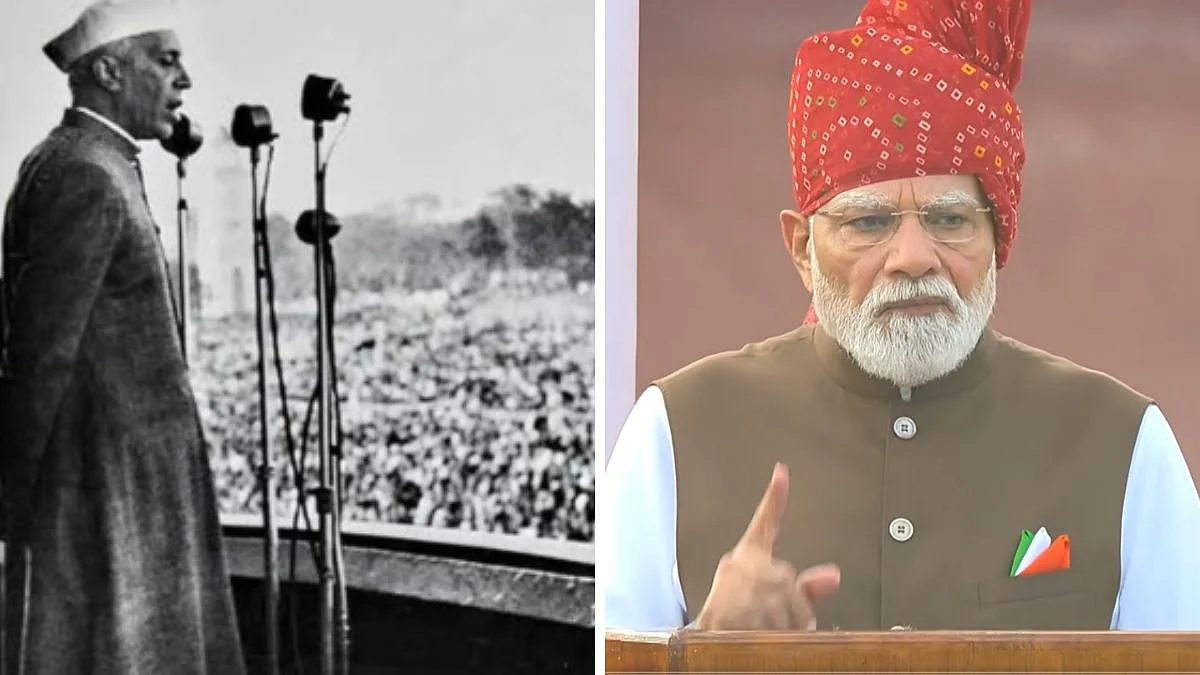
In 1947, India achieved independence from British colonial rule, with Jawaharlal Nehru declaring the country's freedom at midnight. The fledgling nation faced the challenge of integrating princely states and maintaining peaceful diplomacy in its foreign policy. India's military transitioned from a colonial force to a national entity, prioritizing civilian control and democratic decision-making.
The Defence Committee of the Cabinet, supported by the Ministry of Defence and Armed Forces Headquarters, oversaw the military and strategic planning. India's strategic prowess was demonstrated during the First Kashmir War (1947-48), where it faced a Pakistani-backed invasion and successfully drove the invaders out. Brigadier Rajendra Singh and Major Somnath Sharma were among the key figures who displayed exceptional valor during this conflict.
The Indian Army achieved a decisive victory at Shalateng in November 1947, utilizing IAF air support and precision strafing. The 1949 Karachi Agreement led to a ceasefire, and the Cease-fire Line (CFL) was established. In December 1961, India launched Operation Vijay, a 40-hour tri-service campaign that liberated Goa, Daman, and Diu from Portuguese rule.
This action, driven by the Portuguese attacks on Indian vessels, marked the end of 450 years of Portuguese presence in India. However, the 1960s also witnessed renewed external aggression as Pakistan, under Prime Minister Lal Bahadur Shastri, launched Operation Gibraltar in 1965, infiltrating 7,000 guerrillas into Kashmir. India responded by crossing the international border and attacking Lahore and Sialkot, leading to a brief but intense clash marked by the Battle of Chawinda, the largest tank battle since World War II.
The conflict ended with a UN ceasefire and the Tashkent Declaration, restoring pre-war positions. In 1971, India faced a significant internal crisis when Pakistan launched Operation Searchlight, resulting in the displacement of ten million refugees into India. This triggered a swift 13-day tri-service campaign by India, which involved the Army, Air Force, and Navy.
The Army executed a rapid land invasion, the Air Force established air superiority, and the Navy enforced a blockade, ultimately leading to the unconditional surrender of 93,000 Pakistani personnel and the emergence of Bangladesh. The victory in 1971 solidified India's strategic confidence, but the geopolitical landscape continued to challenge the nation.
In 1984, India discovered Pakistan's plans to occupy the Saltoro heights with specialized Arctic gear. Prompted by this revelation, Prime Minister Indira Gandhi authorized Operation Meghdoot, which involved the airlifting of 300 troops onto the Siachen Glacier using helicopters. This operation secured India's control over the glacier, a strategic high-altitude region, by April 17, 1984. The Siachen Glacier remains a disputed territory between India and Pakistan to this day.
Written by urgent.news from Free Press Journal's reporting — not their text. Machine-written — may contain errors; check the original before relying on it.