Post-Quantum TLS for Cloud APIs and Microservices
Learn how to migrate cloud TLS to X25519MLKEM768 by treating every TLS termination as a separate boundary, with telemetry, fallback controls, and rollout gates.
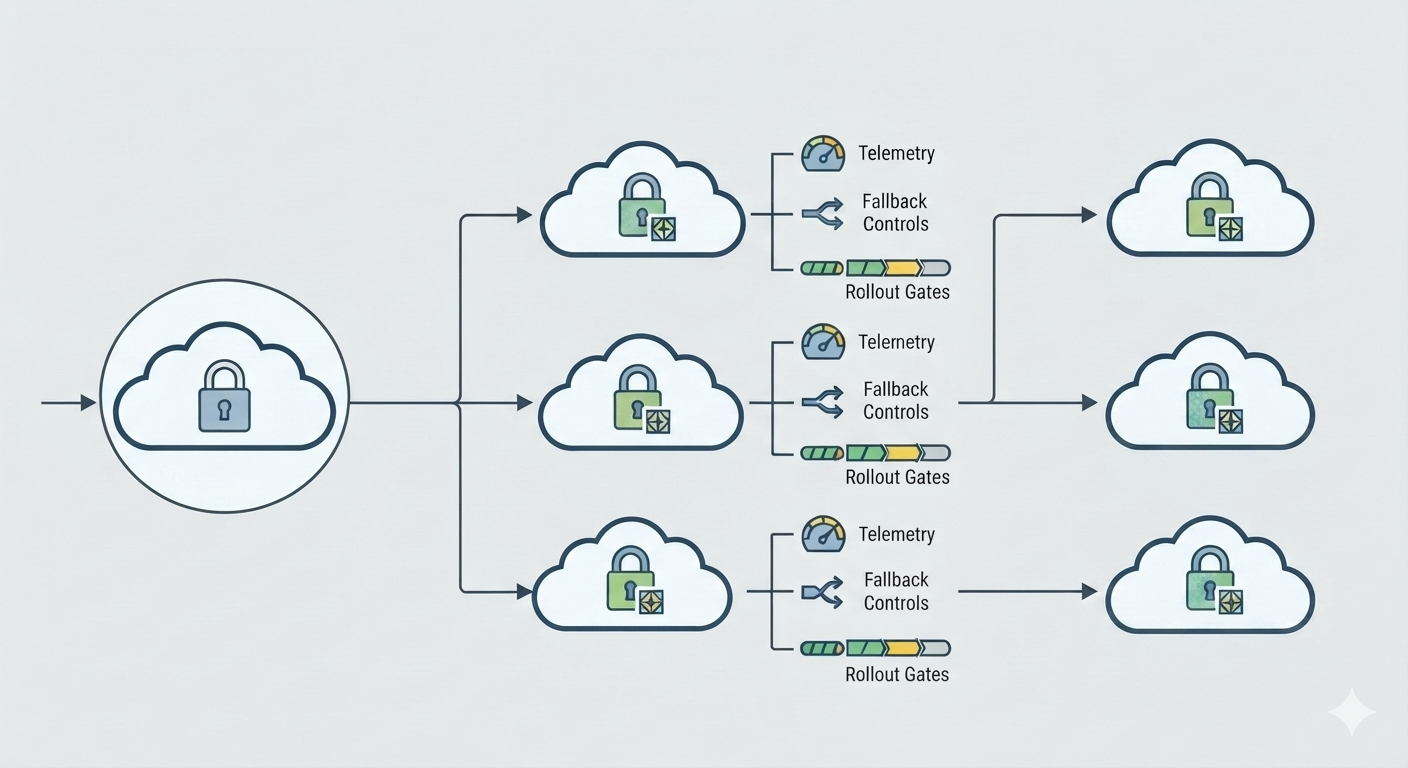
Every TLS termination within a cloud application constitutes its own migration boundary. A single API request can undergo decryption and re-encryption at various points, including a CDN, web application firewall, API gateway, load balancer, service-mesh proxy, application runtime, and managed cloud endpoint. Each termination establishes a new session.
This architectural aspect must be considered when implementing post-quantum TLS. The appropriate unit of migration is not a hostname, service, cluster, or application. Instead, it is the directional TLS link between two adjacent termination points, encompassing an owner, policy, negotiated group, and runtime evidence.
One should view the request path as a graph, with nodes representing clients, gateways, proxies, workloads, and managed services. Each edge corresponds to an independently negotiated TLS connection. For every edge, document the source and destination, the team or provider responsible, the data's confidentiality duration, the full-handshake rate, the chosen key-establishment group, the authentication algorithm, the policy that generated the configuration, and the evidence confirming the outcome.
This link-level model helps avoid misleading labels, such as "PQC enabled." A client may advertise a hybrid group without the server adopting it, a gateway can negotiate hybrid on ingress and classical TLS to the backend, and a service mesh might provide pervasive mTLS while still using classical certificates.
The cornerstone of post-quantum TLS lies in three largely independent cryptographic decisions in TLS 1.3: the symmetric record cipher and hash, the key-establishment group, and the authentication mechanism. X25519MLKEM768 focuses on changing the key-establishment group, combining classical X25519 with NIST-standardized ML-KEM-768 and passing both 32-byte shared secrets through the TLS 1.3 key schedule.
This hybrid construction aims to maintain session secret protection even if either component remains secure, assuming the combiner and transcript assumptions hold. However, it does not render an RSA or ECDSA-signed certificate quantum-resistant nor alter AES-GCM record protection. The hybrid setup only enhances recorded-traffic confidentiality, server authentication, and client authentication in mTLS.
Monitoring should focus on observed behavior rather than configuration intent. A TLS link is deemed post-quantum protected only when empirical evidence demonstrates successful negotiation of an approved hybrid or post-quantum group.
In terms of performance, the X25519MLKEM768 hybrid construction incurs an additional 2,266 bytes in TLS-record bytes due to the inclusion of an ML-KEM encapsulation key in the ClientHello and an ML-KEM ciphertext in the ServerHello. This increase can cause previously small ClientHello packets to exceed packet boundaries, potentially disrupting middleboxes, parsers, or firewalls.
Real-world cloud systems typically employ HTTP/2, long-lived gRPC streams, SDK connection pools, and keep-alive mechanisms. These factors can significantly amplify the initial handshake overhead, eroding the perceived advantage of implementing X25519MLKEM768. Estimating CPU and bandwidth overhead requires considering requests per connection, cold starts, failover situations, connection-pool disruptions, and other operational variables.
Capacity tests should encompass these scenarios rather than relying solely on steady-state traffic. A directional, versioned, and explicit control plane is necessary to manage the varying support for hybrid groups across different products, versions, and binary builds.
Written by urgent.news from HackerNoon's reporting — not their text. Machine-written — may contain errors; check the original before relying on it.