Climate change: Should we take a walking holiday instead?
Tourism accounts for around nine percent of global CO2 emissions. So, should your next holiday only be to the neighbouring town? A two-day trial in Willich, North Rhine-Westphalia.
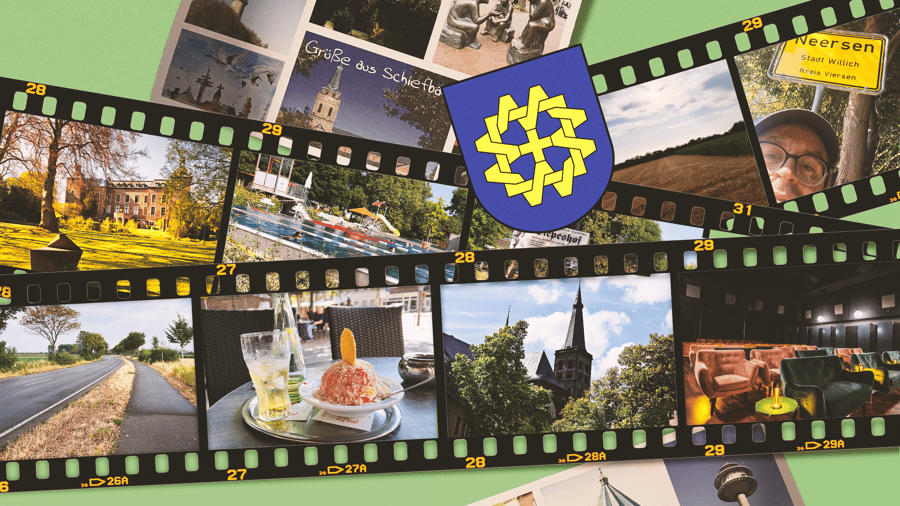
The city of Willich, North Rhine-Westphalia, has a nice sentence on Wikipedia: "The traffic policy of Willich is entirely geared towards individual motorized transport." There are five motorway junctions and a motorway intersection within the city. It's as if the residents are supposed to be reassured: You can always get away quickly.
But I want to go there. I want to go on holiday there. The city where I live is called Krefeld and is located in North Rhine-Westphalia. It borders seven other cities. In one of them, I go shopping, in another to the cinema, in another I change trains to long-distance traffic. I don't really know the other four. I know Berlin, Hamburg, Munich, and even Freiburg better.
That's actually a shame. What I don't understand is: Why do people get into a car, train, or plane for several hours to call what they do at their destination a holiday? After all, you can't escape yourself. So why travel so far? That's why I want to go on holiday in one of the neighboring towns I don't know in the next two days.
It's the end of July. The plan has not only to do with the fact that the concept of long-distance travel, i.e., everything outside of one's own federal state, doesn't convince me. There's also a tangible argument: Around 9% of global CO2 emissions are due to tourism, mainly because of the journey. This means: Better take a holiday right on your own doorstep.
After all, Germans still prefer to travel within Germany. According to the German Tourism Analysis 2026, a quarter of those surveyed named Germany as their travel destination. But probably more often Westerland than Willich. I only know the city of Willich from driving through it on the way to Ikea. A city with around 50,000 inhabitants, spread across Willich, Schiefbahn, Neersen, Anrath, located between Krefeld, Mönchengladbach, and Düsseldorf.
Willich has definitely not yet appeared on the tourist scene. Does the holiday work here just like elsewhere? That's what I want to find out. The weather is already right. It's forecast to be over 30 degrees. Arriving is especially beautiful for those who have been traveling for a long time. Small problem: From my own place to the hotel bed, it's less than eight kilometers.
By car, I'd be at my destination in less than ten minutes. But check-in is only possible from 3 pm on Wednesday. So I decide to walk and take a detour to see some sights. That way, eight kilometers become twenty. My luggage fits into a backpack. Others stroll on holiday, I stroll into the holiday. The nice thing about it: The holiday starts immediately. No airplane cabin, no car body separates me from the outside.
For about the first kilometer of the way, I still know the route. As I walk, I experience the surroundings anew because I experience them at a different speed and on different roads. It takes a while for me to notice that I know this bike path. I've been on it dozens of times, but turned off at a different point. It's like with a song that I first can't associate with a band because I usually hear it as part of an album.
At least one break belongs to the journey. The motorway service station is out, but in the Münchheide industrial area, there's "Carmen's break station". A snack bar with a front tent, where working people can get sandwiches, scrambled eggs, and currywurst. While I eat two cheese sandwich halves, I immerse myself in the reading of the "Bild" newspaper lying on the table.
This also belongs to the holiday: reading the "Bild" newspaper because it's available everywhere. "There must finally be some rain!", demands a headline about the low water level. No mention of climate change in the article.
When I arrive at my destination after 20 kilometers, several of which are only separated from the motorway by a noise barrier, with my T-shirt sticking to my back, it's half past four. Now I really just want to go to my room.
Inspecting the hotel room Willich's largest hotel is a location of B&B Hotels in the industrial area. Since vacation feelings don't really arise there, I decide on an accommodation with the somewhat complicated name "Schlafgut! Hotel-Will.Ich Garni". It's located in the Schiefbahn district. After ringing several times, the operator opens, apologizes several times for the wait, and promises to bring me something from the baker as compensation the next morning.
The man addresses me informally and tells me that he's been running the hotel alone since his parents' death. No Motel One, no standard hotel, just eight rooms, keys instead of cards. He also shows me my room, which is not standard either, proudly pointing out the new box spring bed and the seven-centimeter-high topper. The obligatory WLAN problems for a holiday also exist. Something with the repeater, which won't be solved until my departure.
The next morning, the operator hands me a bag with chocolate rolls.
Exploring the city To be precise, it's completely uninteresting to explore touristy cities, precisely because they're characterized by tourists. It's not like there are so many hotels in Timmendorfer Strand because the residents don't like to stay overnight at home. But as tourists, we're looking for something authentic. If there's a city that can score in this field, then Willich.
Because where are places authentic? Where there are no tourists. So you can read something from them. Schiefbahn, for example. Full of single-family houses in residential areas and with around 11,000 inhabitants, six dentist practices, one of which is called Will-Ich. That means people let themselves get a bit more done here than what the insurance pays.
And Willich City? Probably not even the residents themselves would claim that their city is beautiful. Willich consists mainly of residential and commercial areas. The city center, on the other hand, is strikingly small, has far too little shade in the summer, and has...
Translated by urgent.news. Machine-written — may contain errors; check the original before relying on it.