Indefinite Bandh Hits Arunachal’s Lekang Over New Government Recruitment Rules
Normal life was disrupted in Arunachal Pradesh’s Lekang circle on Friday as community-based organisations, students’ unions and NGOs began an indefinite bandh against the state cabinet’s decision to introduce uniform eligibility criteria for government recruitment. The shutdown began at 5 am, with protesters blocking roads at key entry points, including Banka Bridge, Bordumsa Gate and Dirak Gate.…
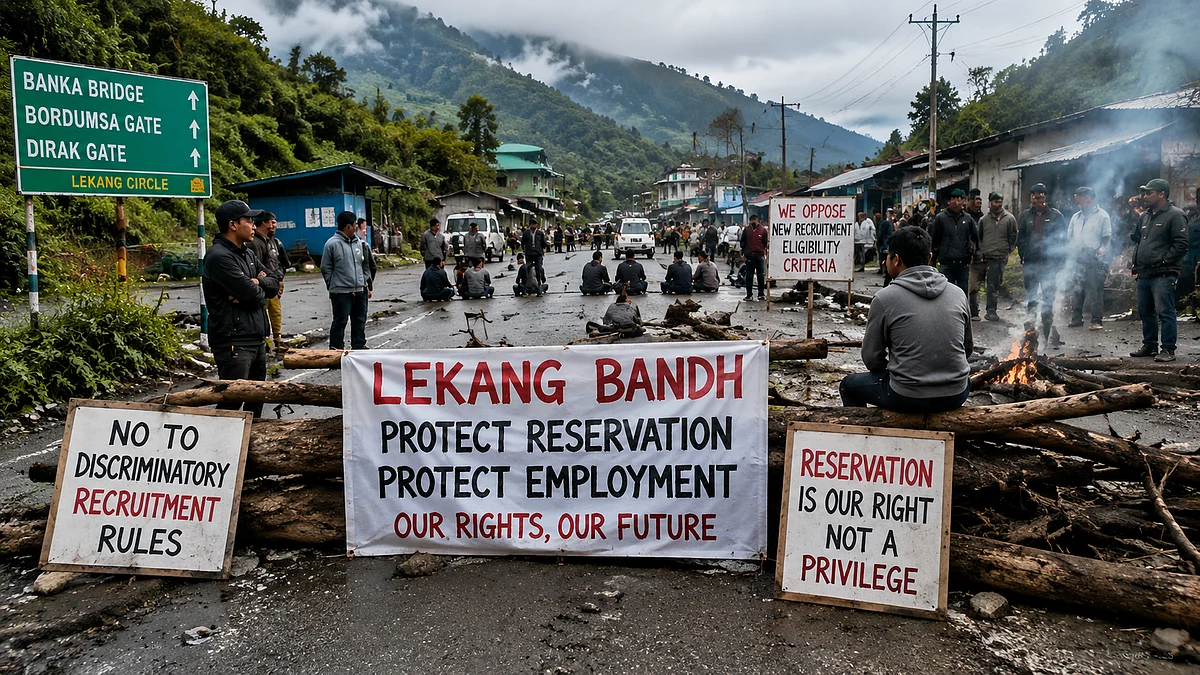
Arunachal Pradesh's Lekang circle witnessed an indefinite bandh on Friday, as community groups, student unions, and NGOs protested the state cabinet's decision to implement uniform eligibility criteria for government jobs. The shutdown started at 5 am, with protesters obstructing roads at crucial entry points like Banka Bridge, Bordumsa Gate, and Dirak Gate.
This protest underscores the apprehension among non-Arunachal Pradesh Scheduled Tribe (APST) residents about the potential impact of the new recruitment rules on their employment prospects, despite their long-standing domicile status.
The new framework mandates applicants to possess permanent residency, APST or indigenous status, and a basic understanding of an indigenous tribal language. The Arunachal Pradesh Public Service Commission (APPSC) and the Arunachal Pradesh Staff Selection Board (APSSB) have been instructed to integrate these criteria into forthcoming direct recruitment for Group A, B, and C positions.
Protest leaders contend that this policy jeopardizes the livelihoods of genuine non-APST residents who hold valid domicile and resident certificates, thereby sparking a debate on how to establish uniform recruitment guidelines without inadvertently sidelining long-standing residents with legitimate claims to state employment.
Horajit Morang, a leader of the protesting organizations, labeled the cabinet's decision as "unconstitutional," warning of potential legal repercussions and questioning the government's stance. He cited the Supreme Court's 1992 ruling in Indra Sawhney v. Union of India, expressing concern that judicial intervention could undermine existing reservation quotas. If a future petition were to strike down or reduce the reservation, he cautioned that the organizations demanding such changes would bear the responsibility.
The existing 80:20 reservation policy, which allocates 80% of vacancies for APST candidates and 20% for non-APST aspirants, forms the crux of the dispute. Protesters worry that eliminating this arrangement would render them ineligible for state jobs, even if they are indigenous inhabitants with historical land survey records dating back to 1968.
For them, the issue transcends recruitment criteria and extends to the question of whether historical residence and domicile should continue to safeguard employment for individuals who have lived in Lekang for decades.
The protesting groups submitted a memorandum to Chief Minister Pema Khandu on August 12, urging the state government and the Joint High-Powered Committee to review historical records and domicile status before finalizing the policy. They emphasized that genuine domicile or resident certificate holders from Lekang should not be excluded from public employment opportunities.
While Morang stated that they would not pursue legal action at present, they vowed to take "democratic steps" if their demands go unmet. Security has been heightened, and talks between Lekang Assistant Commissioner Tojum Ete and the protesting leaders are scheduled for the evening to attempt to ease tensions surrounding the new eligibility criteria.
Written by urgent.news from Free Press Journal's reporting — not their text. Machine-written — may contain errors; check the original before relying on it.