How Will the 21st Century ROAD to Housing Act Affect Housing Supply? Part II
This is the second installment of my look under the hood of the recently passed 21st Century ROAD to Housing Act, looking at what each provision actually does and trying to suss out its actual impact on housing supply.
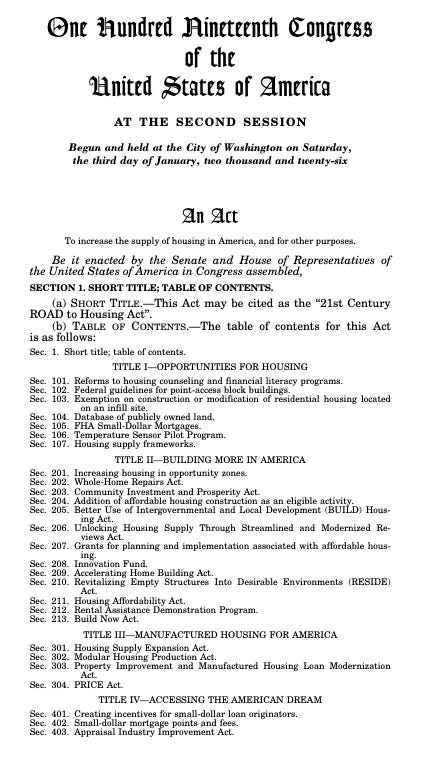
In this second installment of the analysis of the 21st Century ROAD to Housing Act, the focus is on Title II, "Building More in America," and Title III, "Manufactured Housing For America." The act contains 13 and 4 individual provisions, respectively. The author explains that some of these changes are likely to have a major impact on housing supply, while others may not be as significant.
Title II - Building More In America
This title is the largest in the act, with 13 sections targeting housing production and preservation. Each section is addressed individually. Section 201 aims to give additional weight to HUD when awarding housing grants to projects located in Opportunity Zones, which are economically distressed areas with tax incentives for investing.
The author suggests that this section's impact on housing supply is likely to be minimal, as it only shifts the allocation of funds and does not increase the overall budget or the number of funded projects.
Section 202 proposes a HUD pilot program for providing grants to homeowners and landlords for home repairs. This program, modeled on earlier state-level initiatives, aims to provide funding for home repairs such as energy efficiency, weatherization, safety, and general habitability. While this could potentially be a useful program in some cases, the author believes it is more about improving housing quality than increasing housing supply.
The author suggests that repairing existing homes might be more cost-effective than building new ones, as some homes fall out of the housing stock at a slow rate and sometimes damage can accelerate this process. Depending on how the repair funds are distributed, this might result in a meaningful amount of homes being kept in the housing stock.
However, it is likely to be more about addressing quality of life than preventing homes from falling out of the housing stock.
Section 203, the Community Investment and Prosperity Act, raises the cap on banks' investments in public welfare projects, primarily Low Income Housing Tax Credit (LIHTC) housing projects. This program provides tax credits to states, which in turn give them to housing developers for completing projects rented to low-income families.
The author notes that the LIHTC program awards several billion dollars worth of tax credits annually, and roughly 70,000 LIHTC housing units are completed each year. These projects are typically funded by banks, who take on most of the project's equity in exchange for funding and receive the tax credit in return. While the author understands that this change is more about preventing these limits from becoming binding in the future than constraining them currently, they believe it could potentially impact future housing supply.
However, the author views this as a counterfactual deal rather than a direct boost to housing supply over current levels.
Section 204 allows affordable housing projects, including LIHTC housing, to be funded by Community Development Block Grants (CDBG). This is a substantial amount of money, with $3.3 billion awarded each year for housing projects. The author acknowledges that the mechanics of these programs and the constraints on their use make it difficult to gauge the program's actual impact on housing supply. Thus, the author admits to having wide error bars in this section's assessment.
Title III - Manufactured Housing For America
The third title, titled "Manufactured Housing For America," contains four provisions. The author does not detail these provisions in this installment, but they mention that the act's overall impact on housing supply is likely to be limited due to the constraints of the programs and factors that determine whether the changes will be binding or not.
Written by urgent.news from Construction Physics's reporting — not their text. Machine-written — may contain errors; check the original before relying on it.